
A threat hunt reveals that an attacker moved laterally from a compromised workstation to internal database servers using shared administrative credentials. Which countermeasure most directly prevents this lateral movement path in the future?
Select an answer to reveal the explanation.
Short Explanation
If one stolen admin password lets an intruder walk straight from a user laptop into your database tier, your flat network is doing the attacker's job for them. The trap is thinking longer log retention or cosmetic renaming will stop lateral movement.
Full Explanation
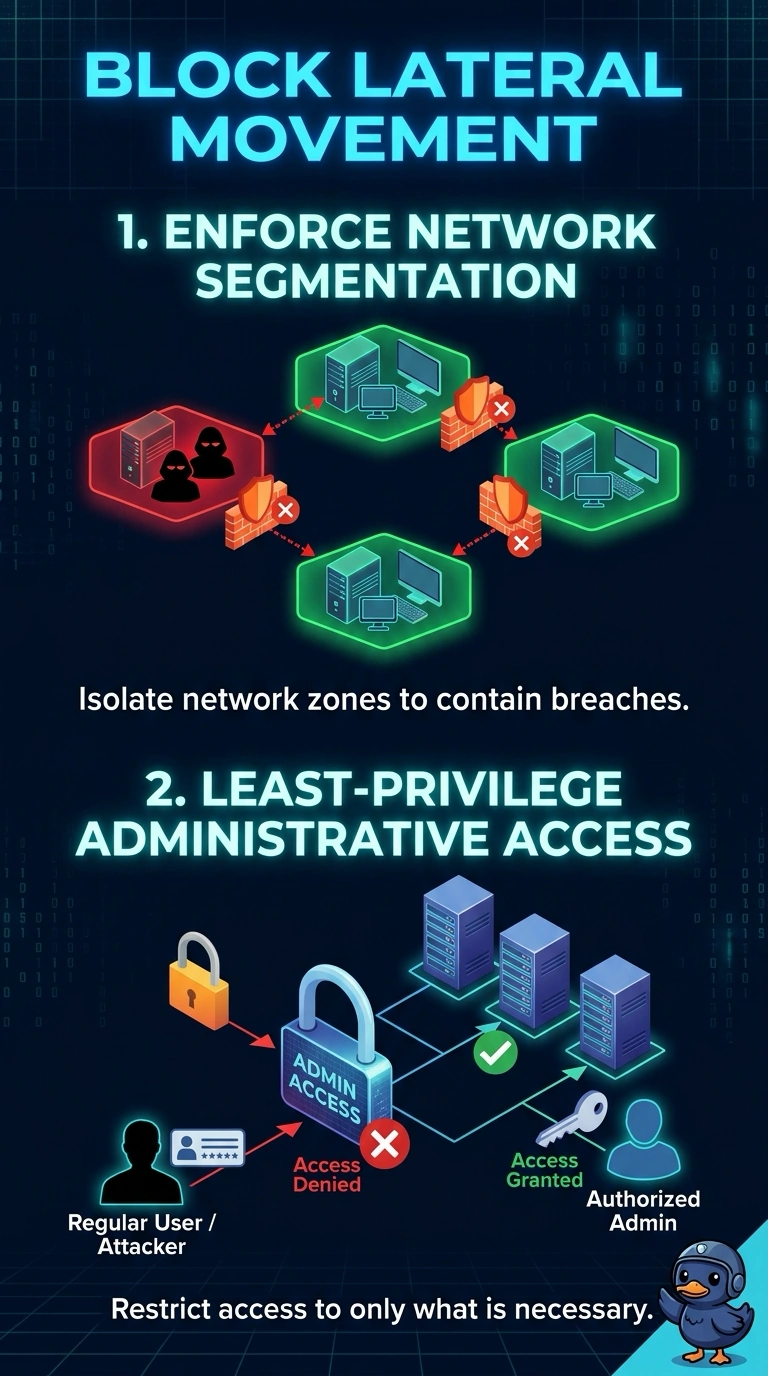
Selecting "Enforcing network segmentation and least-privilege administrative access" is correct because restricting administrative protocols between workstation subnets and sensitive database tiers, while eliminating shared administrative credentials, directly breaks the lateral movement path exposed by the hunt. Conversely, "Increasing the retention period for archived perimeter firewall connection logs" improves historical visibility for future investigations but does nothing to block internal host-to-host movement. Similarly, "Disabling all automated endpoint patching on database servers indefinitely" weakens system security by leaving known vulnerabilities unpatched and has no effect on credential abuse. Finally, "Renaming internal database hostnames without changing authentication policies" relies on superficial obscurity that an attacker can bypass through standard internal service discovery. As an operational caveat, rolling out segmentation and tiered administration requires mapping legitimate management workflows first so database administrators are not locked out during maintenance. For an operational check, verify firewall access control lists between workstation and database VLANs and audit privileged groups to confirm unique, role-scoped accounts.