
A malware analyst examines a suspicious binary that exits immediately when launched inside a standard test VM, hiding its network behavior. Why should the analyst pair static disassembly with dynamic observation during reverse engineering?
Select an answer to reveal the explanation.
Short Explanation
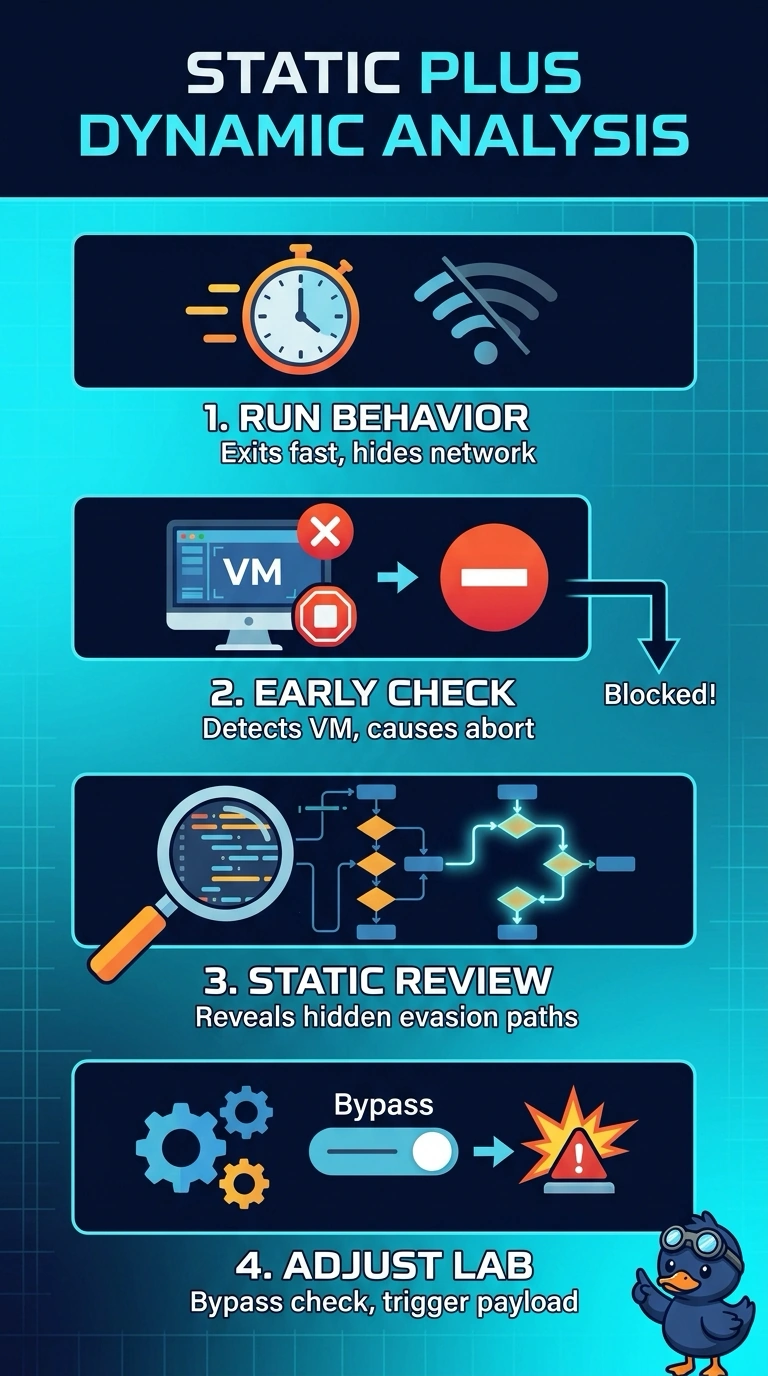
When malware detects your sandbox and quietly quits, running it harder will not make it talk. You pair static disassembly with dynamic observation to see the hidden tripwires, while the trap is assuming either technique alone reveals the whole picture.
Full Explanation
Static review can reveal unexecuted paths and evasion logic missed by a limited runtime trace is correct because inspecting disassembled code reveals environment-detection logic, time bombs, and conditional branches. An early environment check may execute and cause the abort; static analysis can expose that check and the payload paths it prevents from executing. Static tools automatically patch broken executables so they run on any host fails because disassemblers and decompilers inspect binary instructions rather than rewriting broken programs for cross-platform execution. Dynamic execution alone guarantees every dormant code branch will be triggered fails because runtime observation only captures the single execution path taken under those specific sandbox conditions. Disassembly removes all obfuscation without needing to inspect control flow fails because packed or encrypted payloads still require control-flow analysis or controlled runtime unpacking to expose their underlying logic. As a caveat, static disassembly of heavily obfuscated binaries can be time-consuming, so analysts often use dynamic breakpoints to unpack payloads in memory before switching back to static inspection. For an operational check, search disassembled imports and conditional jumps for virtualization or debugger checks, then adjust your isolated analysis environment to confirm whether previously hidden network behavior triggers.