
During a threat hunt at a logistics firm, an analyst confirms that an adversary established persistence on a Linux application server using a rogue cron job and a compromised service account. Which remediation approach best prevents the attacker from immediately regaining access?
Select an answer to reveal the explanation.
Short Explanation
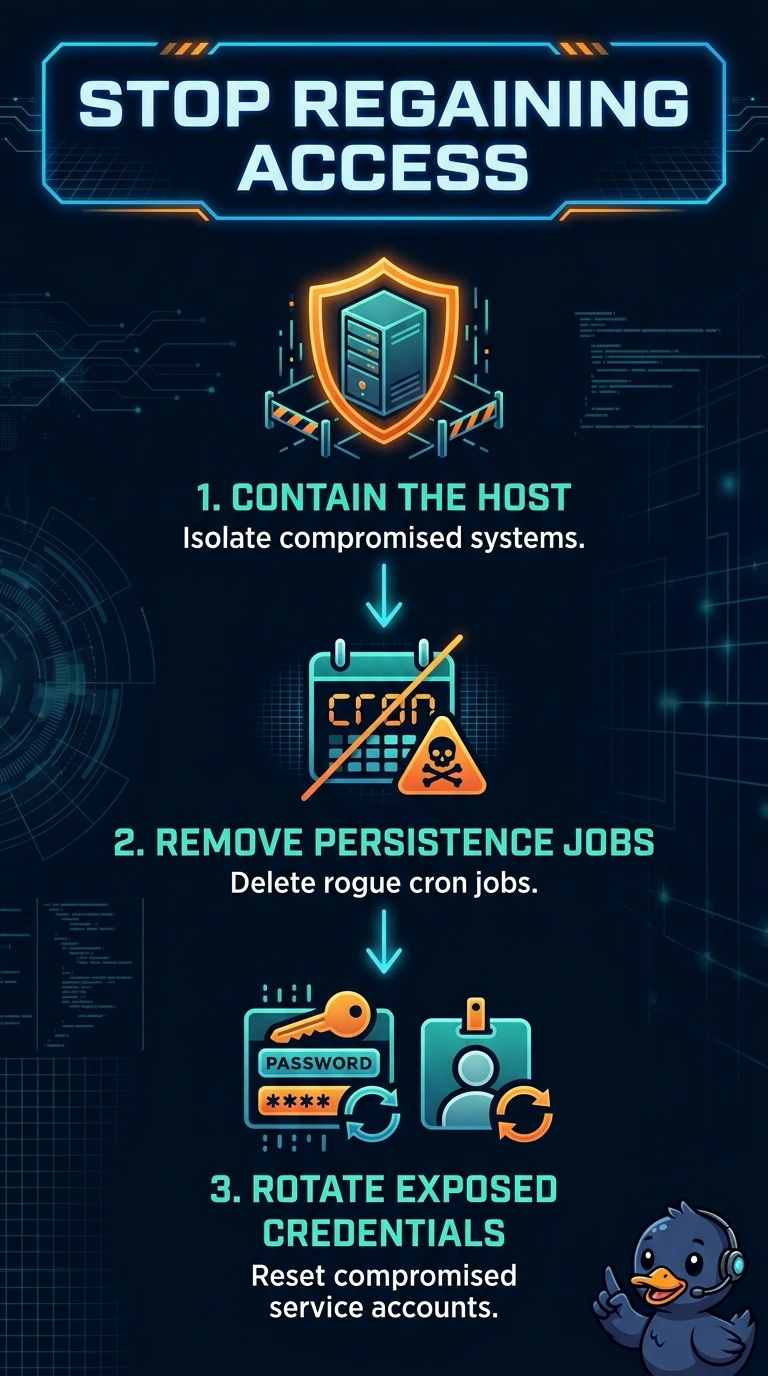
Think of remediation like evicting an intruder who already copied your house keys: locking one door does not help if they still hold a spare. You have to contain the host, strip out the rogue persistence jobs, and rotate the compromised credentials together. The trap is assuming that deleting a single binary or blocking one IP address closes the backdoor.
Full Explanation
Effective remediation requires breaking both the adversary's active foothold and their ability to re-authenticate. Choosing to Contain the host, remove persistence jobs, and rotate exposed credentials addresses the full compromise lifecycle: isolation stops active command-and-control or lateral movement, removing the rogue cron job eliminates automated re-execution, and credential rotation invalidates the stolen service account. By contrast, choosing to Delete the suspicious binary from disk and reboot the server right away fails because the surviving cron entry or compromised account lets the attacker redeploy tooling or log back in after restart. Choosing to Block the external destination IP at the firewall and leave the host online leaves the local persistence mechanism and valid credentials intact, allowing the adversary to pivot from another internal host or use a backup channel. Choosing to Run a malware quick scan on the server and archive the local system records helps document the incident but neither evicts an active session nor revokes compromised access. As a caveat, rotating credentials before isolating the host can alert the adversary and trigger destructive fallback actions if live access is still open. For an operational check, verify in authentication and process telemetry that the service account shows no unexpected logins and the scheduled task list remains clean after containment lifts.