
A threat hunting team completes a successful hunt that uncovered unauthorized remote administration scripts across several branch servers. What should the team do next to ensure future occurrences are caught automatically without repeating the manual hunt?
Select an answer to reveal the explanation.
Short Explanation
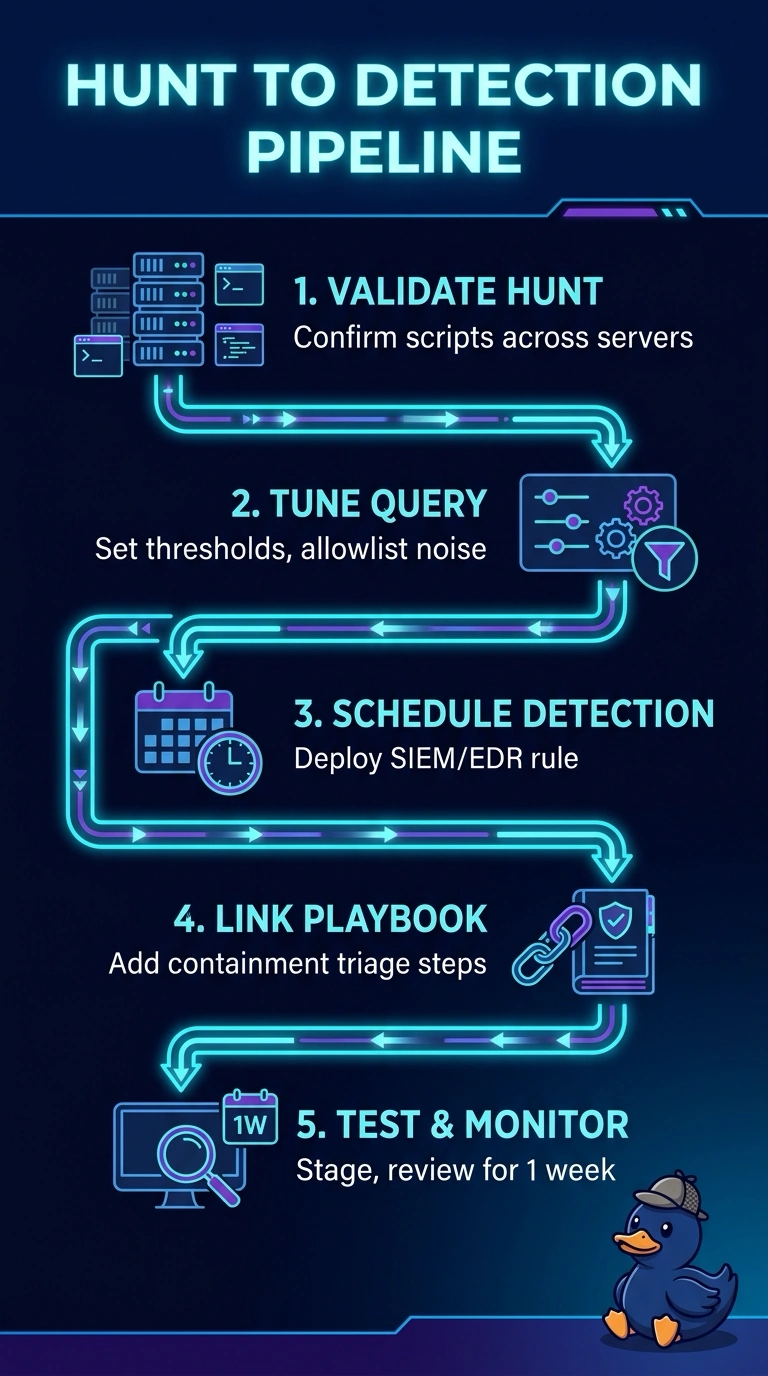
You’ve already done the hard hunting work—now turn the validated query into a scheduled detection with a linked SOC playbook, so future activity is caught automatically. That gives you a repeatable response instead of relying on verbal briefings or another manual hunt.
Full Explanation
Deploying validated queries as scheduled detections with linked SOC playbooks is correct because it turns proven manual hunt logic into production SIEM rules, EDR analytics, and response runbooks that can catch future activity without repeating the hunt. You gain a repeatable path from detection to response rather than relying on analysts to remember the hunt. Deleting the historical hunt notes after closure destroys institutional memory and forces analysts to rediscover validated methods, queries, and context. Restricting hunt findings to verbal team briefings leaves no durable engineering artifact, creates inconsistent triage, and cannot reliably guide SOC action. Disabling alerting on the affected log source removes visibility where unauthorized activity was confirmed, leaving future occurrences undetected. One caveat: raw hunt queries may need threshold tuning and allowlisting before promotion, or they can generate noisy alerts. As a practical check, run each promoted rule in a staging queue for one week, measure alert volume, and verify that its linked playbook gives the SOC clear containment steps.