
A utility provider's threat hunting team wants to detect adversaries performing internal credential harvesting and lateral discovery on endpoints where existing signature rules have blind spots. Which countermeasure provides high-fidelity early warning?
Select an answer to reveal the explanation.
Short Explanation
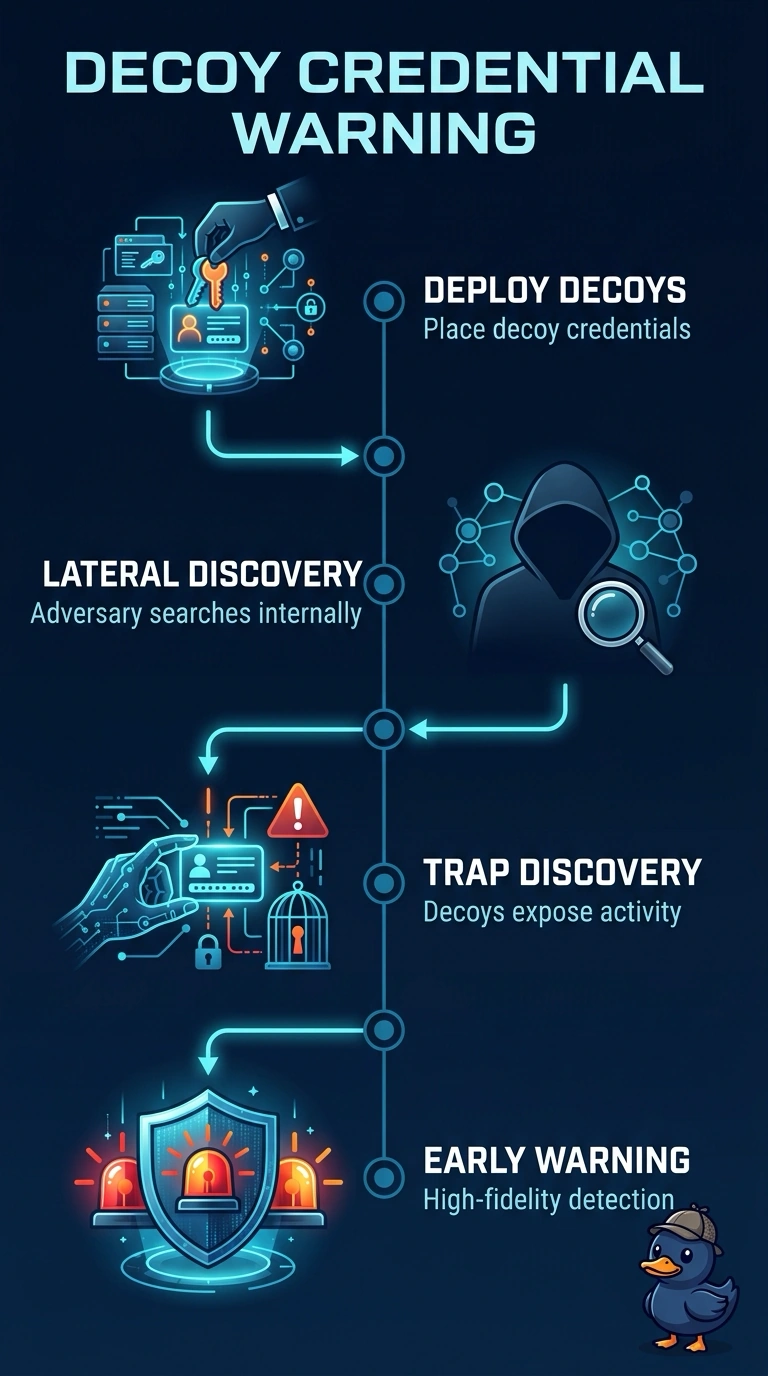
Sometimes the smartest way to catch a prowler isn't adding another camera—it's leaving a marked wallet on the table that nobody legitimate should ever touch. Deception gives you a near-zero-false-positive tripwire, whereas passive retention or disruptive blocks either miss the act or break operations.
Full Explanation
Deploying decoy credentials to trap lateral discovery is correct because deception artifacts—such as honeytoken accounts or canary secrets—have no legitimate business use, meaning any authentication attempt or access immediately signals unauthorized reconnaissance or credential abuse. Increasing firewall log retention to ninety days improves historical investigation capacity, but it does not actively detect internal host-level harvesting that never crosses a perimeter firewall. Blocking all outbound DNS queries from user subnets causes severe operational disruption to normal applications and fails to address internal east-west discovery. Disabling endpoint telemetry during peak business hours creates massive visibility blind spots precisely when user and attacker activity is highest. As a caveat, deception tokens must be carefully isolated from automated backup or vulnerability-scanning jobs so legitimate tools do not trigger false alarms. As an operational check, test each deployed canary account in a controlled window to confirm that authentication attempts generate an immediate high-priority alert in your SIEM.