
An incident responder suspects a Linux server is running a fileless, memory-resident payload that leaves no executable on disk. Which action should the responder take first to preserve evidence?
Select an answer to reveal the explanation.
Short Explanation
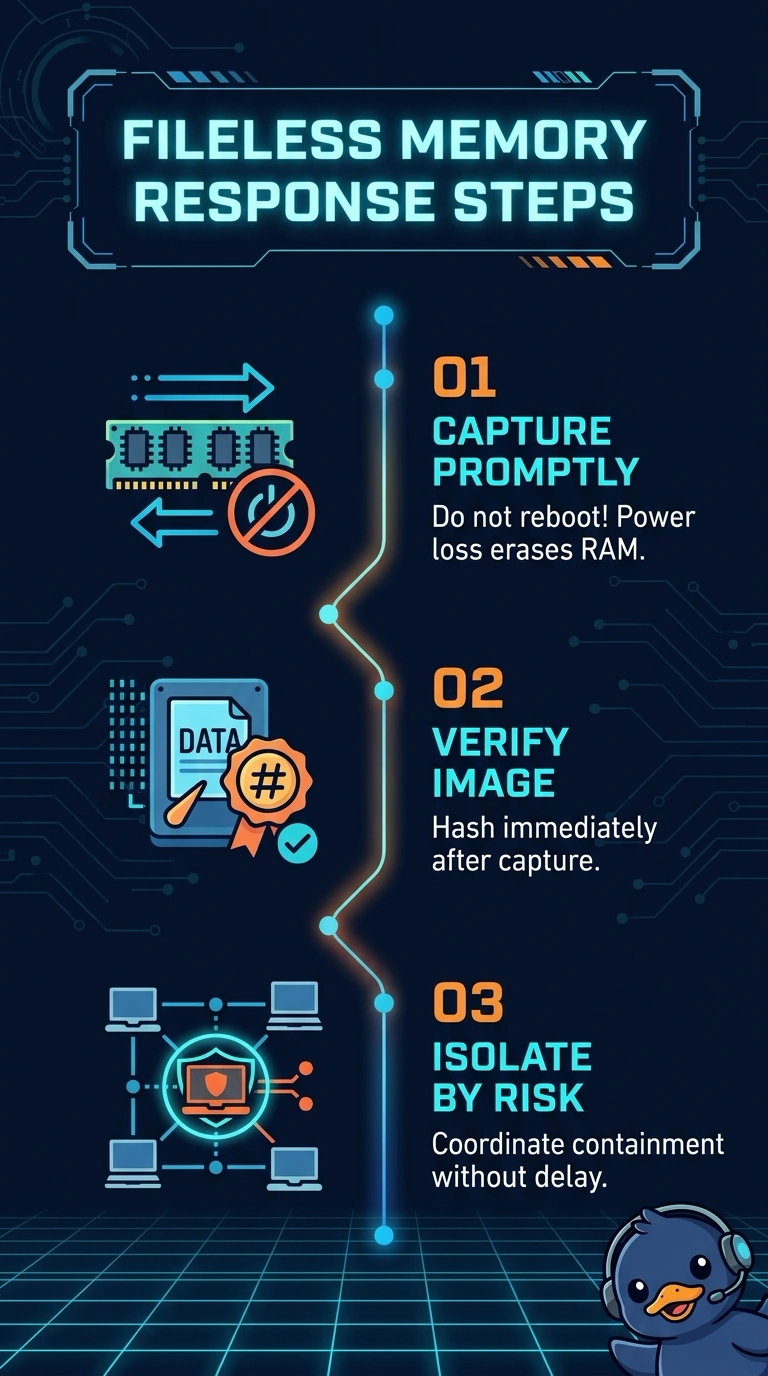
Think of memory-resident malware like writing on a whiteboard that vanishes when you cut power, so you need to capture volatile memory promptly without rebooting. Network isolation generally preserves RAM, although it can change sessions; do not delay urgent containment solely to complete acquisition. You should coordinate isolation according to risk so you preserve evidence without letting the threat spread.
Full Explanation
Capture volatile memory promptly without rebooting preserves active processes, network sockets, injected code, and unlinked binaries that exist solely in RAM and vanish upon power loss, which is essential for analyzing a fileless payload. Network isolation generally preserves RAM, although it can change sessions; do not delay urgent containment solely to complete acquisition. This means coordinating isolation according to incident risk, using a vetted acquisition tool that writes output to external storage and verifying the cryptographic hash immediately after capture to ensure forensic integrity, while accepting that live acquisition slightly alters memory pages. Rebooting the server immediately to clear processes destroys the exact volatile artifacts needed to identify the payload, its command-and-control channel, and its persistence mechanism. Running a full disk antivirus scan and deleting temporary browser files misses code living strictly in memory and risks altering file timestamps without preserving evidence. Formatting the root partition and restoring from backup skips investigation altogether, leaving the original entry vector unpatched and prone to immediate reinfection.