
During a post-incident review, a threat hunting team finds that a SIEM correlation rule linking firewall blocks to endpoint process creation failed to fire, even though both sensors logged the activity. Investigation shows the firewall timestamps lagged behind the endpoints by several minutes. What caused this analytical gap?
Select an answer to reveal the explanation.
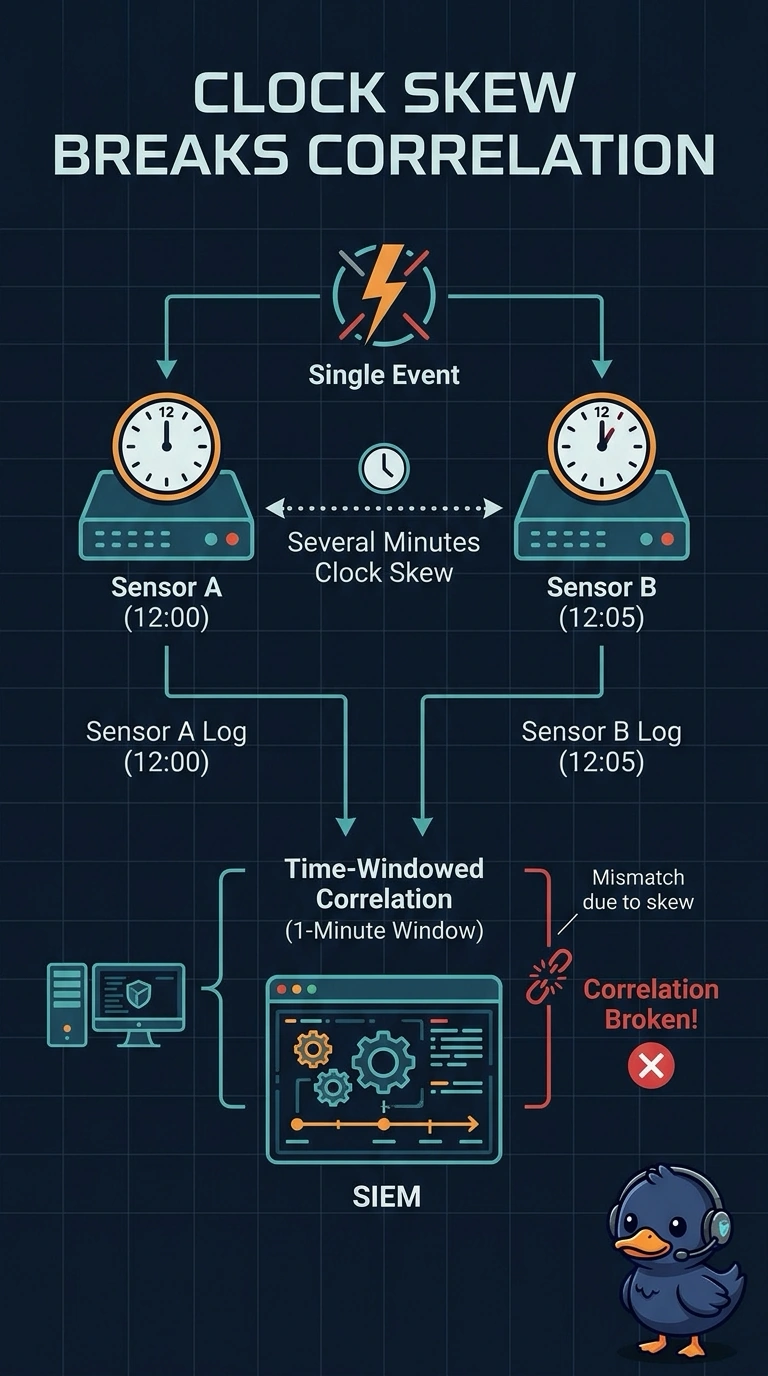
Short Explanation
When you correlate logs from sensors whose clocks disagree, it’s like solving a mystery when every witness’s watch shows a different time. Even when both sensors record the clues, skewed timestamps can push related events outside the SIEM’s correlation window. The key is time synchronization, not missing sensor logs.
Full Explanation
A SIEM correlation rule depends on accurate timestamps to group related events within its time window, so clock skew across sensors explains why the rule did not fire even though both sensors logged the activity. When the firewall clock lags behind endpoint clocks by several minutes, the SIEM may treat the firewall blocks and endpoint process creation as unrelated events. Encrypted endpoint process logs do not explain this gap: the scenario identifies the timestamp mismatch, not encryption, as the problem. Automatic SIEM dropping of firewall events also does not fit, because the firewall activity was logged; its timestamps were simply behind. Using a structured hypothesis instead of machine learning is unrelated to whether timestamps fall within the correlation window. One caveat is that log ingestion latency can resemble clock skew if the SIEM uses arrival time rather than event-generation time. As a practical check, audit Network Time Protocol synchronization across firewalls and endpoints, then compare event-generation timestamps with SIEM ingestion timestamps.