
After a major operating system upgrade across corporate servers, SIEM dashboards still show steady log volume, yet several behavioral lateral-movement rules stop firing entirely. Which analytical gap most likely caused this silent failure?
Select an answer to reveal the explanation.
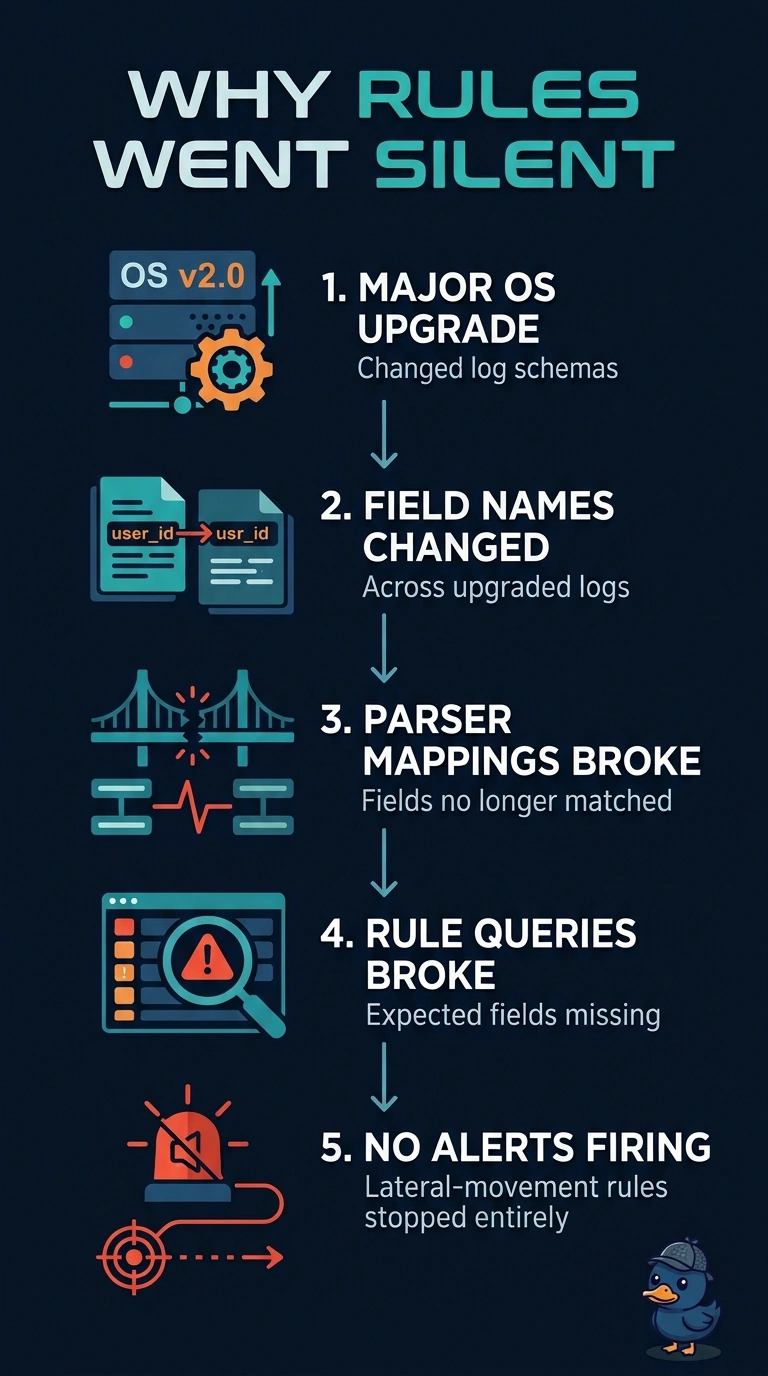
Short Explanation
You can think of an upgraded log schema like renamed spreadsheet columns: formulas that rely on the old names quietly break even when the rows are still full of data. Here, schema drift can leave log volume steady while rules can no longer read the fields they need. The useful check is whether the incoming fields still match the SIEM’s parser mappings and queries.
Full Explanation
Schema and field-name changes in upgraded logs can break existing SIEM parser mappings and rule queries, explaining why behavioral lateral-movement alerts stop firing even though log volume remains steady. Rules depend on expected field names and value structures; raw events may still reach the SIEM, but unmapped fields can prevent correlation logic from matching. Endpoint agents automatically disabling local security auditing policies during reboot would affect auditing, not explain a parser or schema failure by itself; steady total volume also does not rule out loss of selected audit event types, so inspect event-type coverage as well as field mappings. Network switches dropping all encrypted syslog packets immediately after the server upgrade would reduce ingested log volume rather than silently disable only these rules. A SIEM license expiring on the day maintenance concluded would typically halt ingestion or produce platform licensing errors, not selectively break rule queries. One caveat is that schema drift can also occur when vendor log-shipper agents update independently of the operating system. As a practical check, compare raw events from an upgraded host with the SIEM’s active parser schema, then validate each affected rule against those events.