
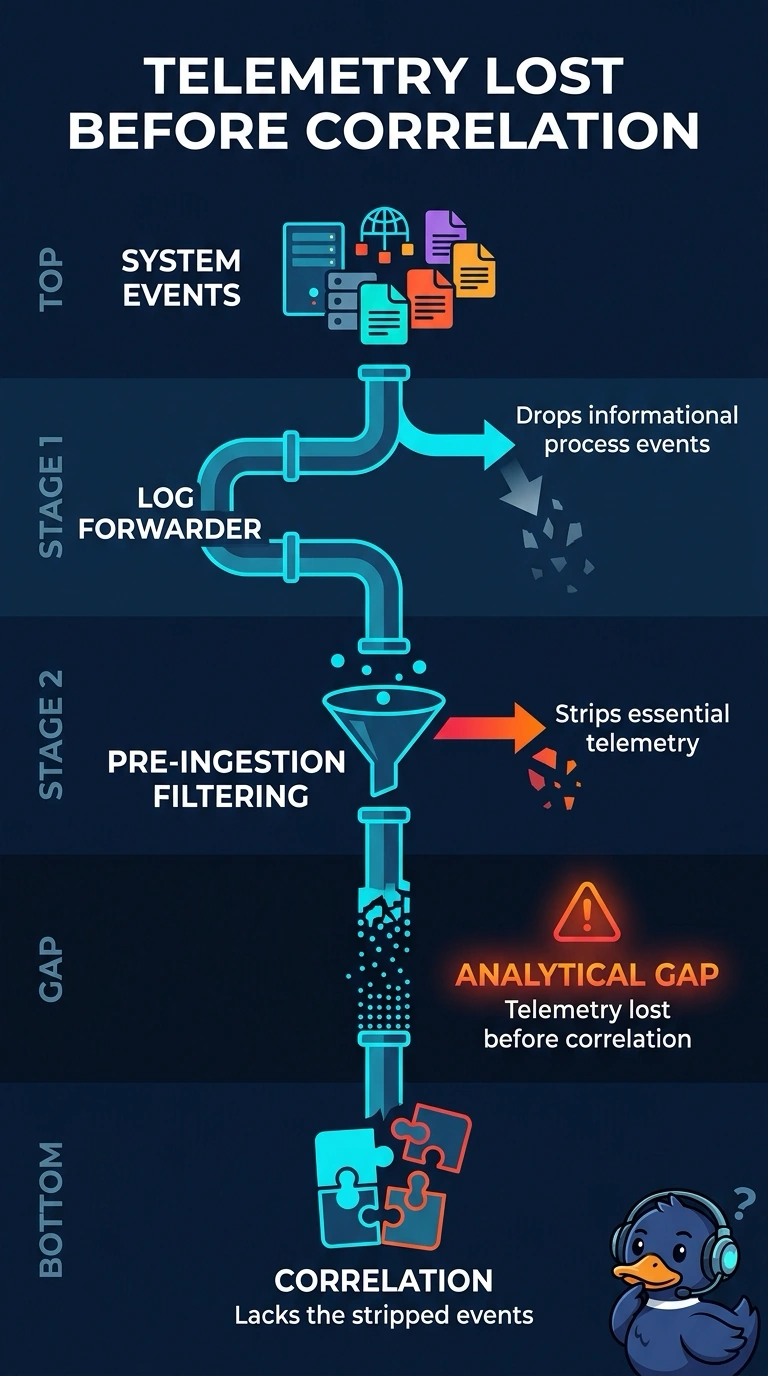
During a post-incident review, a threat hunter discovers that an attacker executed reconnaissance commands on several workstations without triggering SIEM behavioral rules, even though endpoint agents were healthy and clocks were synchronized. Investigation shows the log forwarder was configured to drop informational process events to save bandwidth. What analytical gap does this illustrate?
Select an answer to reveal the explanation.
Short Explanation
If your security camera is set to delete every clip where no alarm rang, you will never see the intruder who picked the lock quietly. The trap is assuming healthy agents and synced clocks guarantee the SIEM actually receives the low-level events your rules need.
Full Explanation
Aggressive bandwidth or licensing optimization at the endpoint forwarder creates Pre-ingestion log filtering stripping essential telemetry before correlation. Because behavioral hunting rules often rely on routine process-creation or logon events that individual sensors classify as informational, dropping those events upstream blinds the SIEM even when agents are online and timestamps match. Pointing to Encrypted TLS traffic preventing perimeter network sensors from inspecting payloads describes a network visibility issue rather than missing local process-creation logs. Blaming Insufficient threat intelligence feed frequency for newly registered domains does not explain why local reconnaissance commands failed to reach the SIEM. Citing Overly broad machine learning risk thresholds hiding high-severity alerts assumes the underlying events arrived in the SIEM, which did not happen here. As a caveat, ingesting every raw debug event indiscriminately can overwhelm storage, so filter only verified high-volume noise rather than core process telemetry. For an operational check, run a controlled test command on a lab endpoint and confirm the expected process-creation event arrives intact in the SIEM index.