
During a post-incident review, a threat hunting lead discovers that compromised workstations communicated with an external server over IPv6, yet the SIEM showed zero corresponding firewall or DNS alerts. Which analytical gap most likely caused this blind spot?
Select an answer to reveal the explanation.
Short Explanation
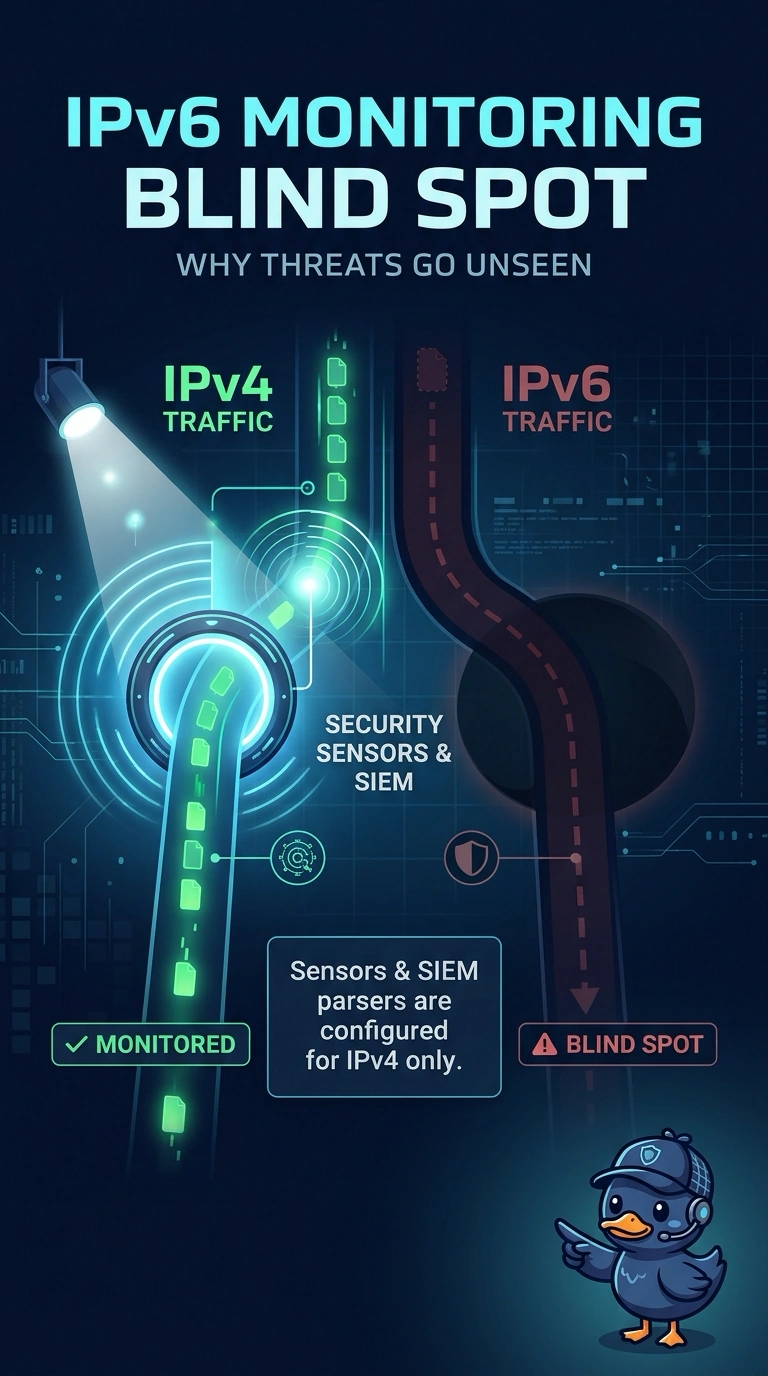
Imagine installing motion sensors only on your front door while leaving the side gate wide open. The trap is assuming your firewall and SIEM see all network traffic when dual-stack hosts quietly route sessions over unmonitored IPv6 paths.
Full Explanation
Security sensors and SIEM parsers were configured to monitor only IPv4 traffic explains this blind spot because modern operating systems often prefer IPv6 when dual-stack connectivity is available, allowing adversaries to bypass IPv4-centric inspection and logging pipelines. If firewall policies, DNS resolvers, or SIEM normalization rules ignore IPv6 address formats, outbound sessions vanish from analyst dashboards. IPv6 flow visibility and DNS record visibility are separate checks: AAAA queries can travel over IPv4 DNS transport, and IPv6 connections can use hardcoded addresses. Validate address-family policy, AAAA parsing, and actual resolver usage instead of assuming IPv6 sessions imply IPv6-transport DNS. By contrast, The workstations were powered off before the SIEM could complete its nightly batch sync would not selectively omit IPv6 sessions, and enterprise SIEMs ingest logs near real time. Similarly, The endpoint security agents automatically encrypted all local process-creation logs does not explain missing firewall and DNS alerts for external sessions. Finally, The external command-and-control server used a static IPv4 address on a standard port contradicts the observed IPv6 communication and would have matched IPv4 rules. Match visibility to what the network permits, and audit firewall, DNS, and SIEM parsers with test IPv6 traffic to confirm alerting.