
During a post-hunt review, an analyst finds that endpoint and firewall clocks are synchronized, yet real-time SIEM correlation rules still fail to link related events because firewall logs arrive 45 minutes late. Which analytical gap explains this failure?
Select an answer to reveal the explanation.
Short Explanation
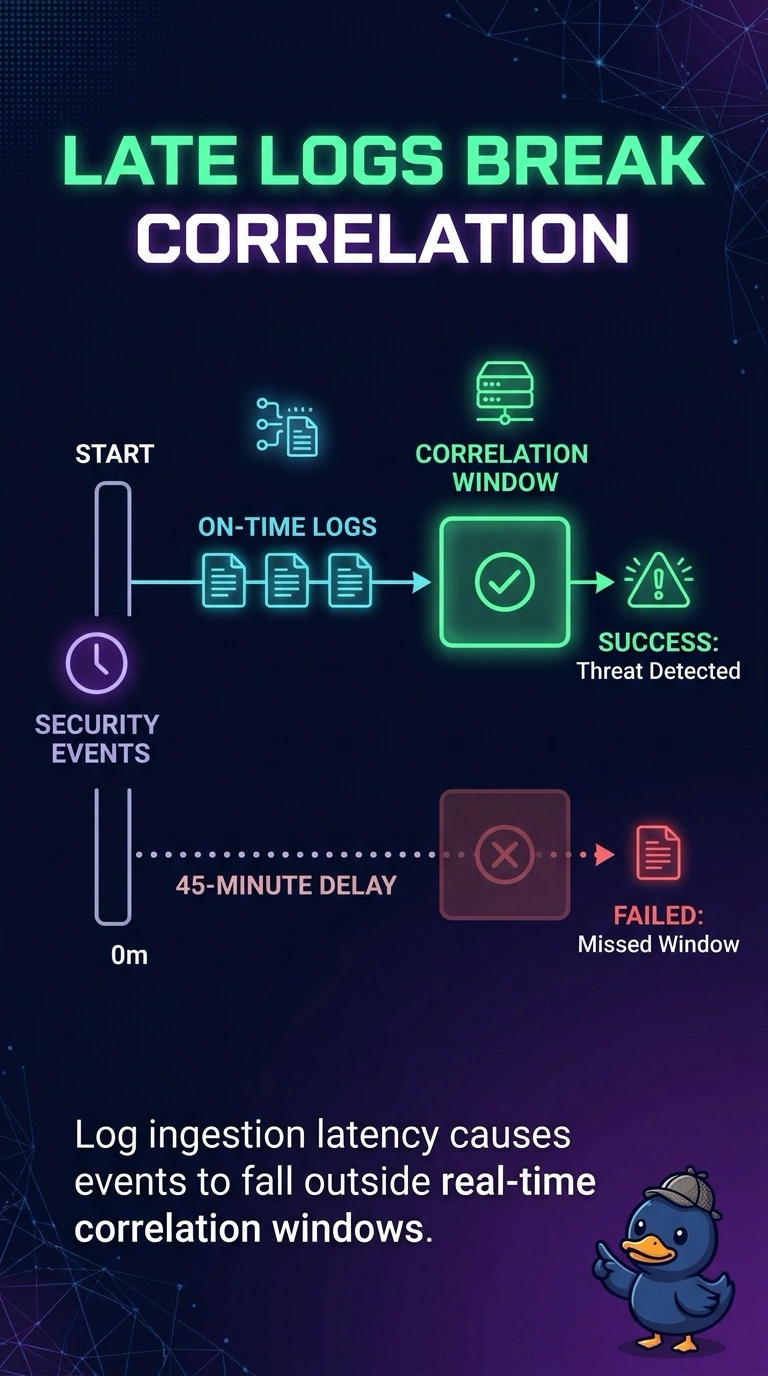
Even if every watch in your building is set to the exact second, a 45-minute mail delay still breaks real-time matching. The trap is blaming endpoint log stripping or firewall filtering when pipeline latency is what breaks your correlation.
Full Explanation
Identifying that Log ingestion latency causes events to fall outside real-time correlation windows pinpoints why synchronized clocks alone cannot guarantee multi-source rule matching. Correlation can miss delayed events when arrival/processing windows, event-time lookback, or allowed-lateness handling are insufficient. Configure and test the actual SIEM’s event-time and delayed-event behavior rather than assuming every engine uses ingestion time. When firewall telemetry arrives 45 minutes after the corresponding endpoint event, the window has already closed. Blaming the miss on Endpoint agents are stripping command-line arguments from process logs ignores the stated fact that the failure involves linking endpoint and delayed firewall records rather than missing process strings. Assuming that Perimeter firewalls are blocking all outbound DNS resolution requests describes an unrelated network outage rather than a delayed log-delivery pipeline. Pointing to SIEM storage retention policies are deleting alerts after ninety days confuses long-term archival aging with a 45-minute real-time ingestion lag. As a caveat, widening correlation windows indefinitely can increase memory load and false positives. Run an operational check by measuring the delta between event generation timestamps and SIEM index timestamps across all critical log forwarders.