
During a post-incident review, a threat hunting team discovers that an attacker executed reconnaissance scripts from a standard administrative directory without triggering any EDR alerts. Investigation shows the directory was globally excluded to reduce backup software noise. What analytical gap does this reveal?
Select an answer to reveal the explanation.
Short Explanation
Silencing noisy alerts by muting an entire folder is like unplugging a smoke detector because burnt toast annoyed you. The trap is blaming sensor timing or missing hashes when your own exclusion list hid the attacker.
Full Explanation
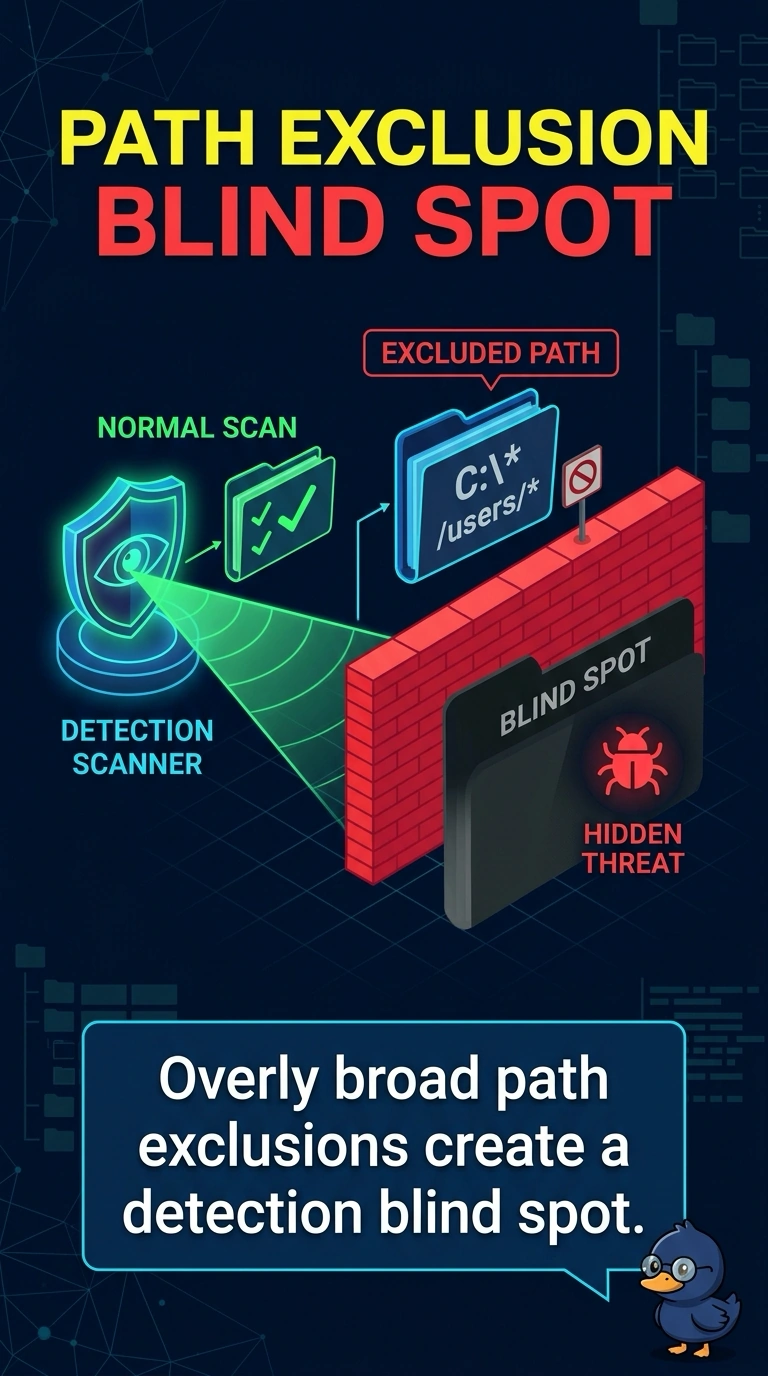
The root cause is that Overly broad path exclusions created a detection blind spot. The configured sensor-level exclusion suppressed the relevant detections in this case. Exclusion effects depend on product, platform, and policy type; antivirus path exclusions do not universally suppress EDR telemetry or behavior detections. In contrast, The EDR agent failed to maintain network time synchronization with the SIEM would break cross-sensor correlation timestamps rather than preventing the endpoint agent from generating a local alert in the first place. Pointing to The threat intelligence feed lacked hashes for built-in system utilities misses the point because EDR detections for reconnaissance scripts rely on behavioral telemetry rather than static hash feeds. Similarly, The perimeter firewall failed to decrypt outbound internal backup traffic is irrelevant to local script execution happening inside the endpoint directory. As a caveat, noisy enterprise tools like backup agents do require tuning, but exclusions should be narrowly scoped by signed publisher, specific binary hash, and exact parent-child process lineage rather than whole folders. For an operational check, audit all EDR and SIEM suppression rules quarterly and test whether unauthorized scripts placed in excluded paths still generate telemetry.