
After an authorized technical adversary-emulation exercise executes test activity that should match SIEM correlation rules without generating alerts, a lead hunter investigates why the detections stayed silent. Which diagnostic step best identifies the analytical gap?
Select an answer to reveal the explanation.
Short Explanation
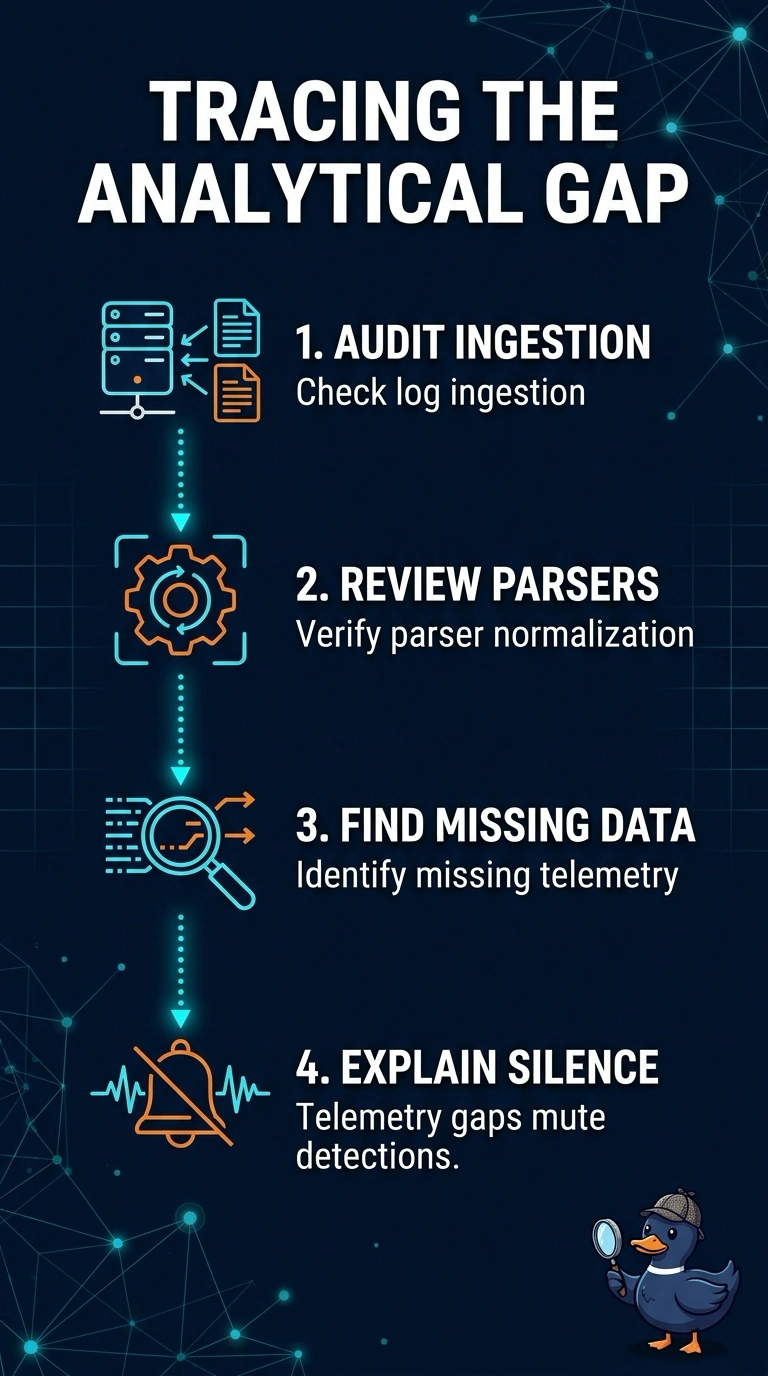
If your smoke alarm never rings during a drill, you check whether the battery is dead before blaming the siren. Auditing log ingestion and parser normalization shows you if required fields ever reached the SIEM. The trap is tweaking alert thresholds or removing quiet rules instead of checking the data pipeline.
Full Explanation
When expected detections fail to fire, the best diagnostic action is to audit log ingestion and parser normalization for missing telemetry. Correlation rules depend on specific log sources arriving reliably and mapping into expected schema fields; dropped forwarders or broken parsers silently blind entire detection categories. Choosing to increase the SIEM alert severity threshold to reduce daily analyst queue volume suppresses notifications further rather than explaining why an event went undetected. Choosing to disable correlation rules that have not triggered during the past ninety days removes valid coverage for low-frequency, high-impact threats. Choosing to replace all endpoint sensors with a single perimeter network firewall eliminates host-level visibility into process execution and internal lateral activity. A key caveat is that even when logs arrive intact, rule logic can still fail if expected field values differ across operating system versions. As an operational check, replay the simulated event timestamps against raw indexed logs to confirm whether the telemetry exists and matches the rule's parsed field names.