
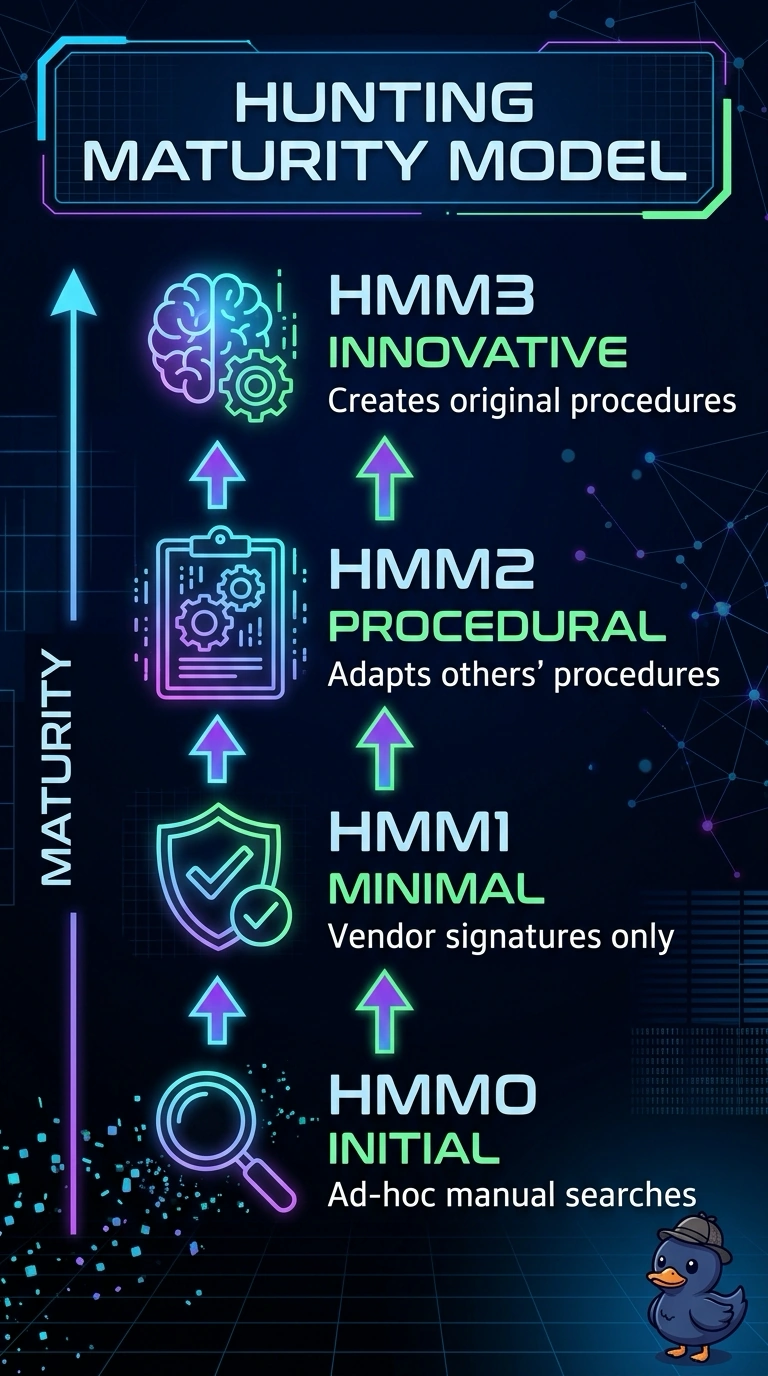
A security team already collects broad telemetry and runs routine hypothesis-driven hunts based on published threat intelligence. The team applies others’ procedures with minor adaptations and has not created original procedures. What capability must the team develop to advance to the next stage of hunting maturity?
Select an answer to reveal the explanation.
Short Explanation
Once you master routine intelligence-led hunts with minor adaptations, your next leap is building your own original repeatable procedures. The trap is slipping back into passive vendor signatures or reactive post-breach searches.
Full Explanation
Selecting "Creating original repeatable data analytics" is correct because advancing beyond routine intelligence-driven hunting requires developing custom data analysis procedures, such as statistical baselining and anomaly clustering, as HMM3 creates original repeatable procedures; previously unknown threats are not required. Conversely, "Relying exclusively on vendor-supplied signature updates for all daily alert generation" represents a passive posture that leaves the organization blind to living-off-the-land techniques and custom tooling. Similarly, "Purchasing additional perimeter firewalls without integrating endpoint telemetry" adds hardware without improving analytical maturity or visibility into internal host behavior. Finally, "Conducting ad-hoc manual log searches only after a confirmed breach occurs" describes reactive incident investigation rather than proactive, maturing threat hunting. As an operational caveat, custom analytics require clean, normalized telemetry and regular tuning to prevent false-positive fatigue as IT infrastructure evolves. For an operational check, review your recent hunt outputs to confirm how many yielded new, repeatable analytical queries rather than one-off manual searches.