
A security architect is threat modeling a new industrial control gateway and wants a structured diagram that maps the branching AND/OR prerequisites an attacker must combine to reach a single high-value target state. Which threat modeling technique fits this goal?
Select an answer to reveal the explanation.
Short Explanation
An attack tree works like a flowchart for breaking into a house, showing which doors can be picked alone and which locks must be opened together. The trap is choosing a static hardware diagram or compliance list when you need logical AND/OR attack paths.
Full Explanation
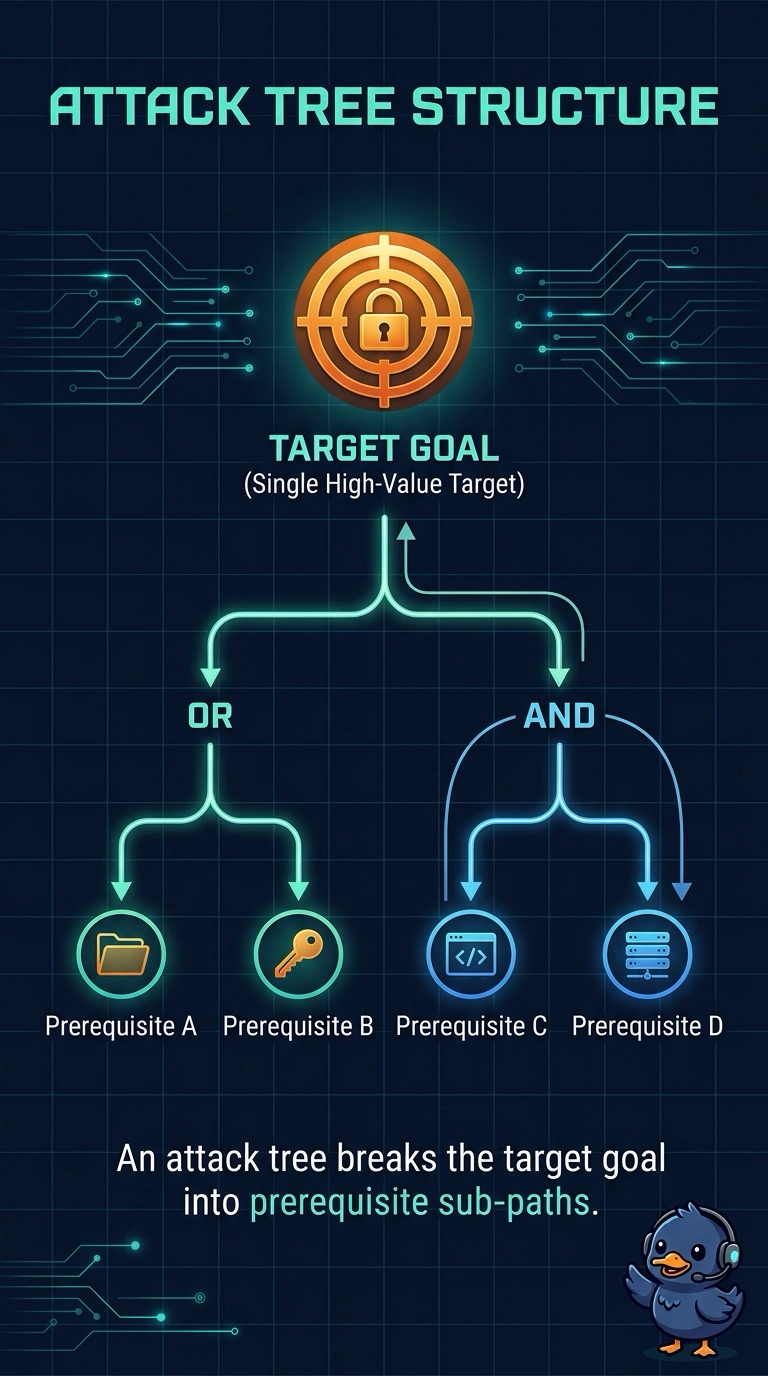
An attack tree breaking the target goal into prerequisite sub-paths fits this need because it places the ultimate compromise objective at the root and branches downward into concrete technical steps linked by AND or OR conditions. This structure helps defenders see where a single control breaks an entire AND chain or where redundant OR paths require layered monitoring. A compliance checklist auditing password length and screen-lock timers is incorrect because it verifies baseline policy hygiene rather than modeling multi-step adversary paths toward a specific gateway objective. A network topology map showing physical switch ports and rack locations is wrong since physical wiring diagrams do not express logical exploitation prerequisites or attacker decision branches. An incident response contact roster listing on-call shift rotations fails because staffing schedules support escalation logistics rather than pre-build architectural threat modeling. As a caveat, attack trees can become unwieldy for large systems unless you scope the root node to a critical asset. For an operational check, review each leaf node against your current SIEM and firewall rules to ensure every high-risk branch has at least one detection or preventive control.