
A security team completed an architecture threat model for a new hybrid cloud application and now needs to plan its first structured threat hunt. How should the team use the threat model to prioritize hunting effort?
Select an answer to reveal the explanation.
Short Explanation
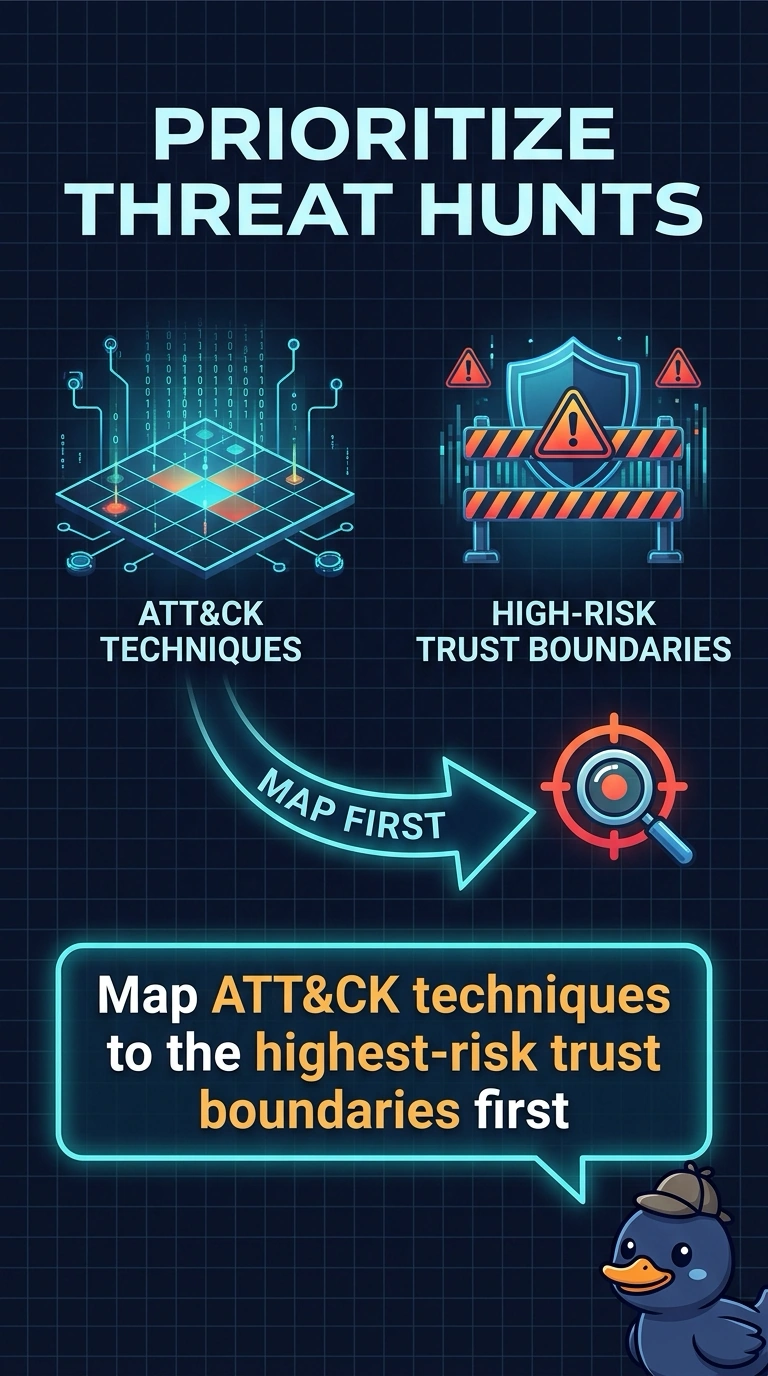
A threat model is your treasure map for defenders—it shows you exactly where the crown jewels sit behind fragile doors. The trap is chasing every generic feed indicator or waiting for an alarm to ring while critical internal boundaries go unchecked. Mapping adversary techniques directly to your highest-risk trust boundaries turns modeling into focused, high-value hunts.
Full Explanation
Threat modeling identifies where data sensitivity, privilege transitions, and network exposure intersect across trust boundaries. When transitioning to active hunting, the most effective strategy is to Map ATT&CK techniques to the highest-risk trust boundaries first so analysts test realistic adversary paths against the architecture's most critical exposure points. Choosing to Focus exclusively on external perimeter firewalls and ignore internal hops leaves lateral movement and privilege escalation across internal cloud-to-on-premises boundaries completely unexamined. Deciding to Search randomly for every published indicator from public threat feeds wastes analyst cycles on unstructured indicator matching that may not even apply to the application's technology stack. Waiting to Delay all hunting until a confirmed breach triggers a high-severity alert abandons proactive defense and leaves blind spots open to stealthy intruders. As an important caveat, remember that threat models reflect assumptions at a point in time and must be updated whenever new integrations or identities are added. As an operational check, verify that your SIEM actually collects the telemetry required to observe each prioritized ATT&CK technique before launching the hunt.