
While building an ATT&CK-based threat model for an enterprise network, a security architect maps several distinct adversary paths leading to critical financial databases. How should the team prioritize defensive controls and hunt coverage across those modeled paths?
Select an answer to reveal the explanation.
Short Explanation
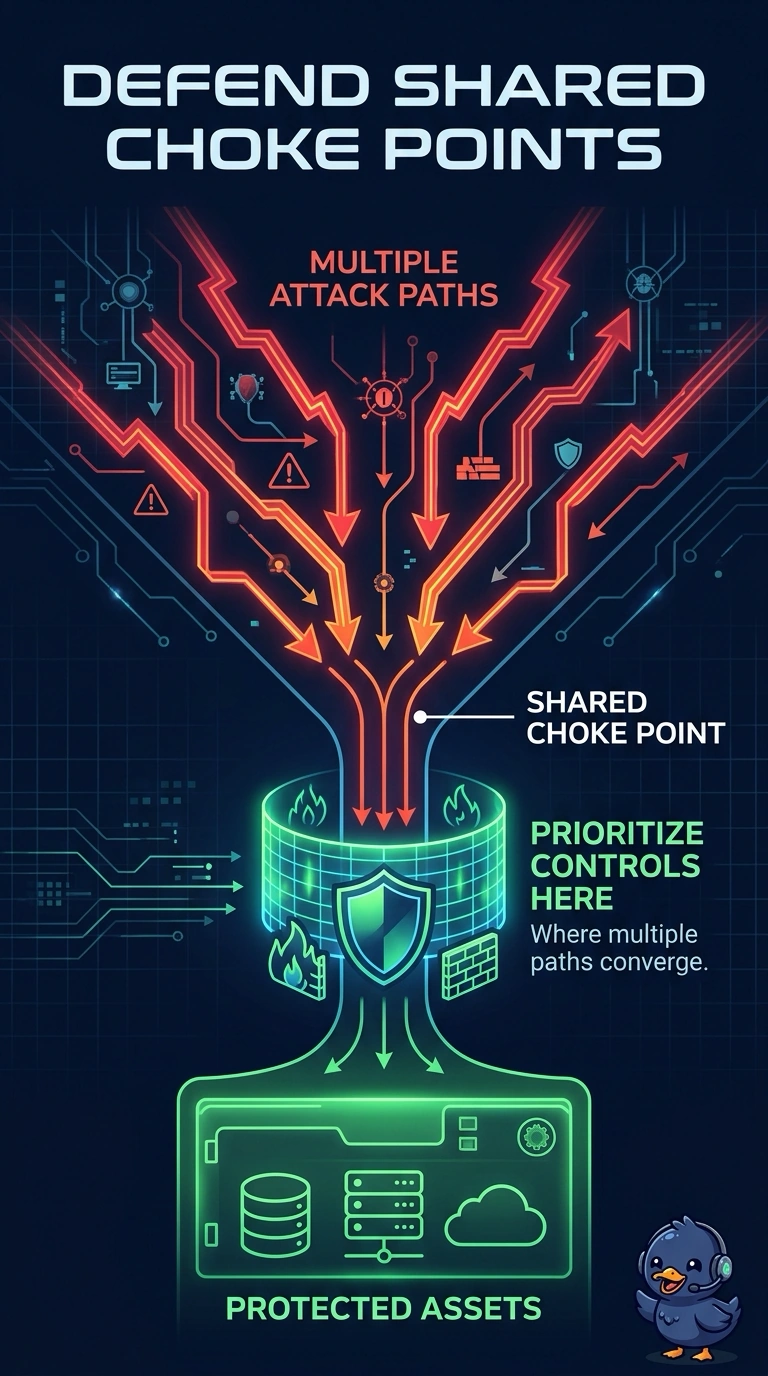
If ten different roads all cross the same narrow bridge, you guard the bridge first. Modeling attack paths lets you spot the shared identity or jump-host choke points where a single control disrupts multiple threats, rather than spreading your team thin across every endpoint.
Full Explanation
When multiple modeled intrusion paths lead to critical assets, defenders get the greatest risk reduction by prioritizing controls at shared choke points where multiple attack paths converge. Choke points such as identity providers, privileged jump hosts, and core network gateways appear repeatedly across different adversary techniques, so hardening and monitoring them disrupts several attack chains at once. Focusing all monitoring exclusively on perimeter firewalls while ignoring internal paths leaves the organization blind once an attacker gains an initial foothold inside the network. Assigning identical detection priority to every low-risk workstation across the network wastes limited analyst capacity on low-impact assets instead of high-leverage bottlenecks. Removing all internal network segmentation to simplify centralized log collection actually widens adversary blast radius and removes natural defensive barriers. As a caveat, choke-point controls must be paired with basic endpoint visibility so attackers cannot bypass centralized paths unnoticed. For an operational check, review your threat model graph to confirm which identity systems or administrative hosts sit on the highest number of paths to crown-jewel assets.