
An enterprise security architect is threat modeling a new customer-facing API and wants to trace how input-validation flaws could lead to post-exploitation lateral movement on backend servers. Which framework combination best supports this end-to-end mapping?
Select an answer to reveal the explanation.
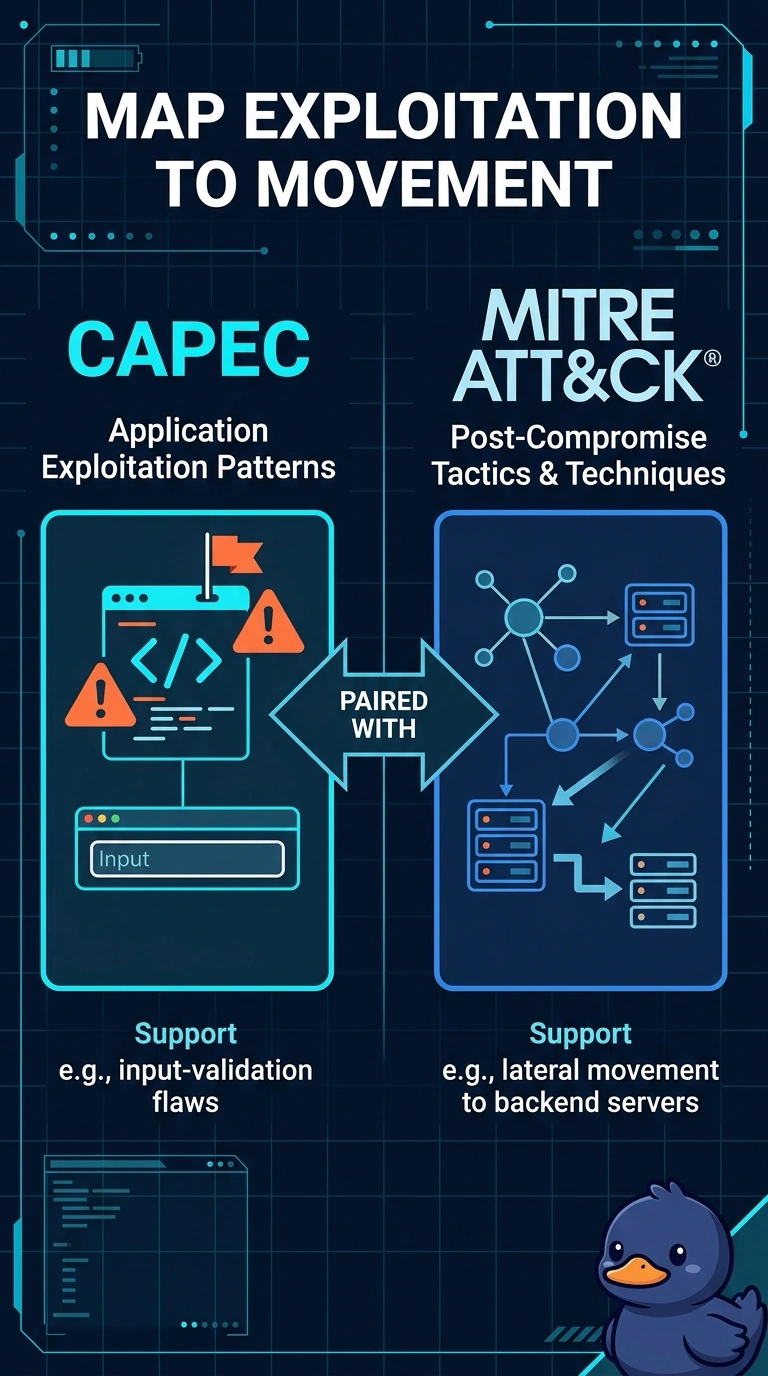
Short Explanation
Think of CAPEC as the lock-picking guide for the front door and ATT&CK as the floor plan of what happens once someone gets inside. Pairing both helps you connect API flaws to backend detections, while the trap is treating application security and infrastructure hunting as separate worlds.
Full Explanation
Pair CAPEC application exploitation patterns with MITRE ATT&CK post-compromise tactics and techniques bridges the gap between software-level weaknesses and host or network adversary behaviors. CAPEC catalogs how attackers abuse application logic and inputs, while ATT&CK maps the credential access, discovery, and lateral movement steps that follow initial execution. By contrast, Use the Pyramid of Pain alone to rank database table schemas by business confidentiality misapplies a model built for indicator durability rather than data classification. Likewise, Apply TaHiTI sprint scheduling to replace architectural data-flow diagrams before coding confuses a threat hunting workflow methodology with a design-time modeling artifact. Relying on the approach to Rely solely on Traffic Light Protocol labels to prioritize which API endpoints need authentication is also incorrect because TLP governs intelligence sharing rather than access control design. As a modeling caveat, mapping every theoretical attack path can overwhelm engineering teams if not scoped to critical assets. As an operational check, review each high-risk API endpoint in the threat model and verify that both application-layer logging and backend host telemetry cover the transition.