
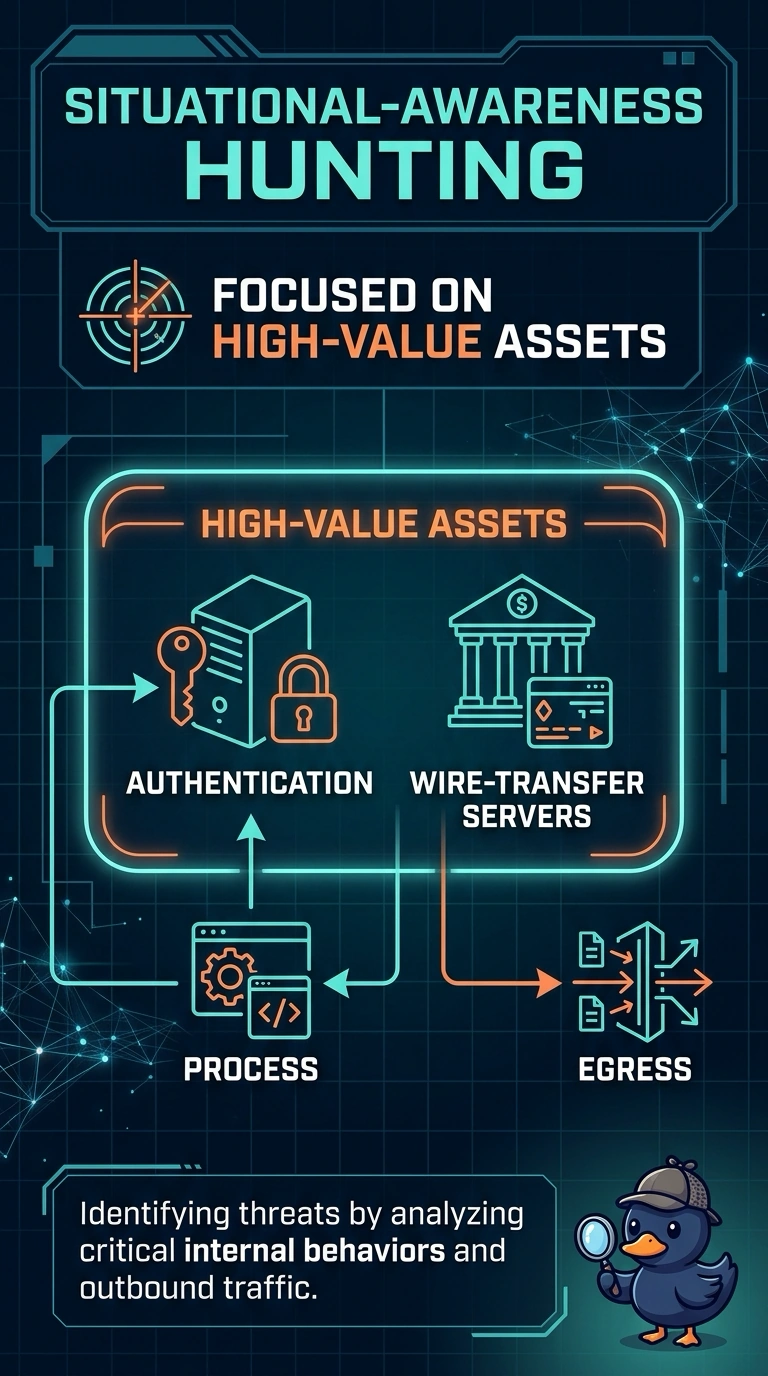
A financial services hunting team decides to spend its next sprint systematically baselining authentication, process, and egress patterns around its core wire-transfer servers rather than chasing external threat feeds. Which hunting style best describes this approach?
Select an answer to reveal the explanation.
Short Explanation
Instead of waiting for a wanted poster, you are watching the bank vault itself. The trap is thinking every hunt must start with an external indicator, when knowing your crown-jewel baselines catches what feeds miss.
Full Explanation
Situational-awareness hunting focused on high-value assets describes this approach because the team scopes its investigation around critical business systems and normal operational baselines rather than external indicators. By understanding what legitimate activity looks like on wire-transfer servers, hunters can spot subtle deviations that never appear in public threat feeds. Reactive alert triage driven exclusively by vendor signatures fails because the team is proactively modeling and inspecting normal asset behavior rather than waiting for automated rules to fire. Atomic indicator sweeping using unverified external IP lists fails because the team deliberately set aside external feeds to focus on internal system telemetry. Ad hoc log browsing with no defined scope or target system fails because the sprint is tightly scoped to specific core servers and defined telemetry categories. As a caveat, situational-awareness hunting requires accurate asset inventories and collaboration with system owners so normal maintenance tasks are not misread as intrusions. As an operational check, review your crown-jewel asset register quarterly and verify that authentication, process, and egress logs for those systems are actively baselined.