
A threat hunting team has no active intelligence alerts for a newly acquired subsidiary, yet wants to uncover unknown compromises lurking in its legacy network. Which hunting approach is most appropriate to start with?
Select an answer to reveal the explanation.
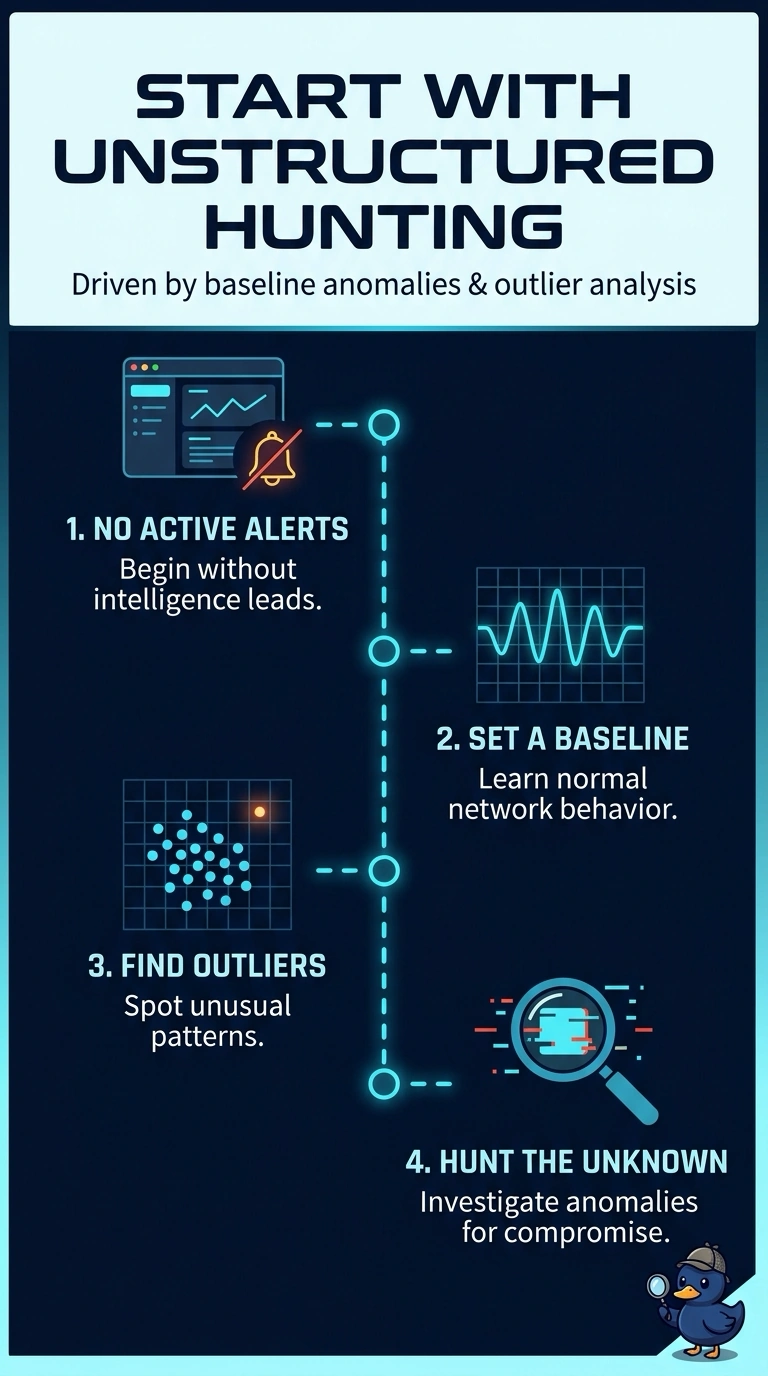
Short Explanation
Exploring an unfamiliar network without intelligence leads is like walking into a dark room with a flashlight—you look for what seems out of place. Avoid waiting on stale indicators when baseline anomalies can guide your first hunt.
Full Explanation
When a team inherits an unmonitored or newly acquired environment without specific adversary intelligence, unstructured hunting driven by baseline anomalies and outlier analysis is the ideal starting point. By examining telemetry distributions—such as rare parent-child processes, unusual service accounts, or atypical egress destinations—hunters surface hidden threats without needing a preexisting hypothesis tied to a specific threat actor. Indicator-only sweeping using expired external IP blocklists is ineffective because threat infrastructure rotates rapidly and stale lists miss active compromises. Waiting for automated perimeter firewall signatures to trigger an incident is passive monitoring, not threat hunting, and misses threats already inside the network. Structured hunting tied strictly to a single named nation-state report is too narrow when you have no evidence that specific actor targets the subsidiary. As a caveat, unstructured hunting can wander without clear boundaries if analysts do not document findings and pivot into structured hypotheses once anomalies appear. Operational check: establish initial frequency baselines for authentication and process execution across the subsidiary's servers and investigate the rarest 1% of outliers.