
A regional utility's threat intelligence team receives dozens of unstructured PDF advisories each week and struggles to transcribe adversary indicators and TTP relationships into its SIEM without delays or transcription errors. Which handling improvement best resolves this bottleneck?
Select an answer to reveal the explanation.
Short Explanation
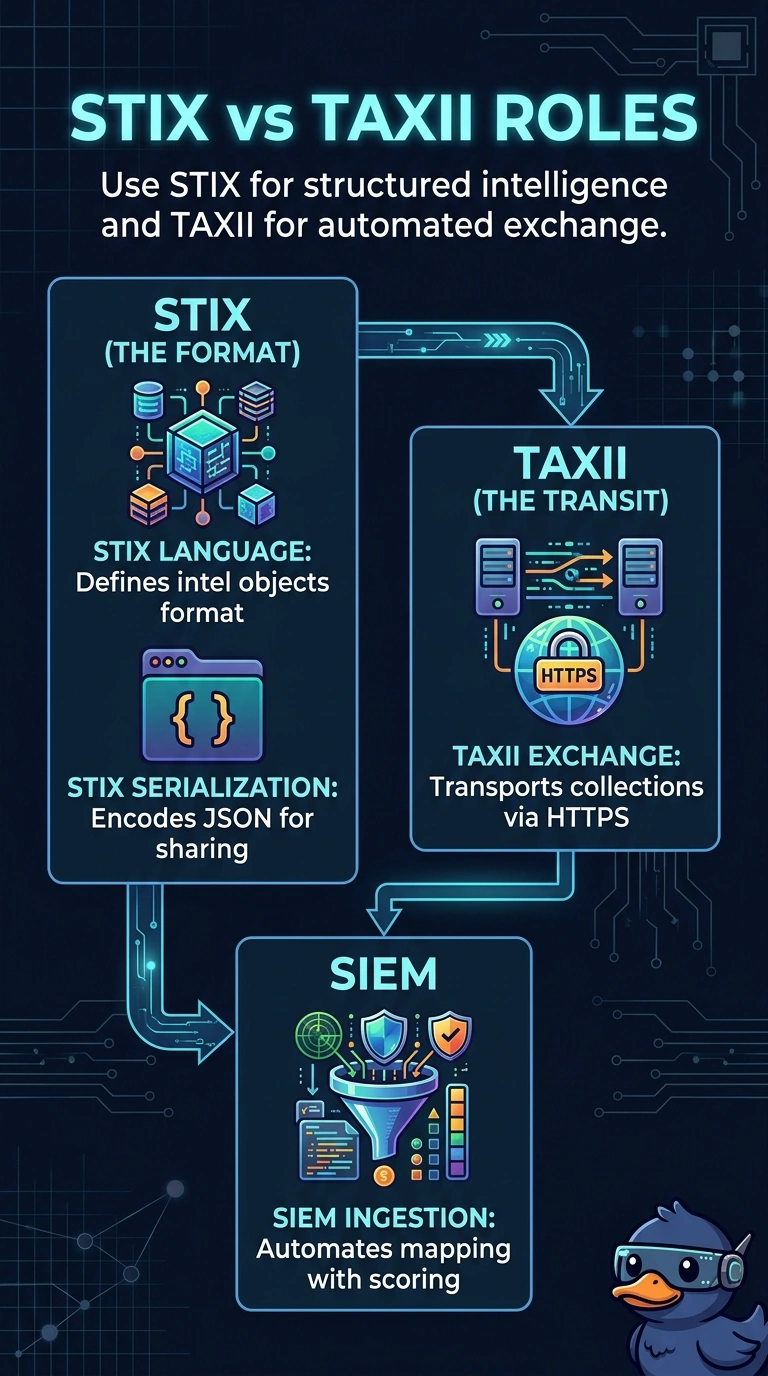
Copying addresses by hand from paper letters into a delivery truck invites typos and delays. You fix this by standardizing how data is expressed and exchanged, not by typing faster. STIX is the intelligence language and serialization format; TAXII is an application-layer exchange protocol.
Full Explanation
The team should Use STIX for structured intelligence and TAXII for automated exchange, because STIX is the intelligence language and serialization format; TAXII is an application-layer exchange protocol. STIX provides a machine-readable schema for indicators, campaigns, and adversary TTPs while TAXII provides the transport to exchange them directly into security tools. Automation eliminates manual copy-paste errors and preserves contextual relationships between observables and behaviors. Convert every incoming threat advisory into manual firewall block rules worsens analyst workload and risks blocking legitimate services without proper validation. Restrict threat intelligence sharing to quarterly executive summaries delays tactical defense and strips away actionable technical observables needed by the SOC. Replace SIEM correlation rules with static file-hash watchlists weakens detection durability because hashes sit at the bottom of the Pyramid of Pain and miss behavioral activity. Caveat: automated ingestion still requires confidence scoring, expiration policies, and allowlist filtering so low-quality external feeds do not flood your SIEM. Operational check: verify that incoming TAXII feeds map cleanly into normalized SIEM fields and attach source reliability and expiration metadata before activating automated alerts.