
A security architect wants to prioritize which detection gaps to address first across an enterprise network by mapping adversary behaviors to sequential attack phases from initial access through impact. Which combination best supports this prioritization?
Select an answer to reveal the explanation.
Short Explanation
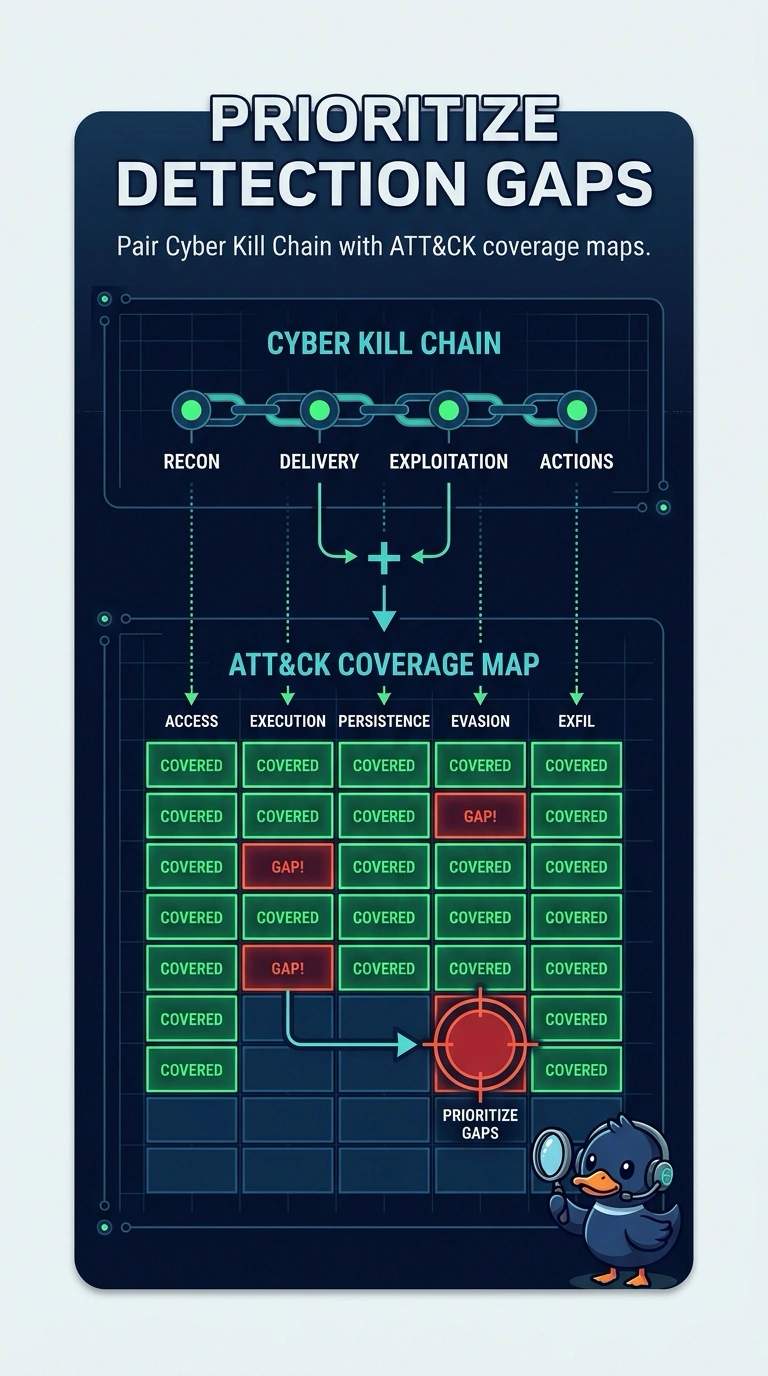
Pairing the Cyber Kill Chain with ATT&CK is like combining a highway map with street-level traffic cameras so you see both the route and the chokepoints. The trap is chasing isolated alerts without tracking where defenses fail across the full attack lifecycle.
Full Explanation
Effective threat modeling connects high-level intrusion progression with concrete adversary behaviors. Pairing Cyber Kill Chain phases with ATT&CK tactic coverage maps lets an architect trace how an intruder advances sequentially while pinpointing specific tactics where sensor visibility or alerting is absent. Use Kill Chain phases as a high-level organizing aid; ATT&CK tactics are not a mandatory linear sequence, and attacks may repeat, skip, or overlap behaviors. By contrast, Sorting all vendor vulnerability alerts strictly by publication date ignores asset exposure, attack paths, and actual adversary behavior, leading to poorly prioritized engineering effort. Blocking every newly registered domain observed in passive DNS logs causes severe operational false positives for legitimate business partners and fails to model internal post-compromise movement. Replacing all endpoint telemetry agents with perimeter packet capture removes host-level process and credential visibility, creating massive blind spots rather than structured prioritization. As a caveat, lifecycle mapping must be updated whenever new cloud services or identity workflows are introduced. As an operational check, overlay existing SIEM rules onto the combined phase-and-tactic matrix and schedule hunts targeting any unmonitored early or mid-stage transitions.