
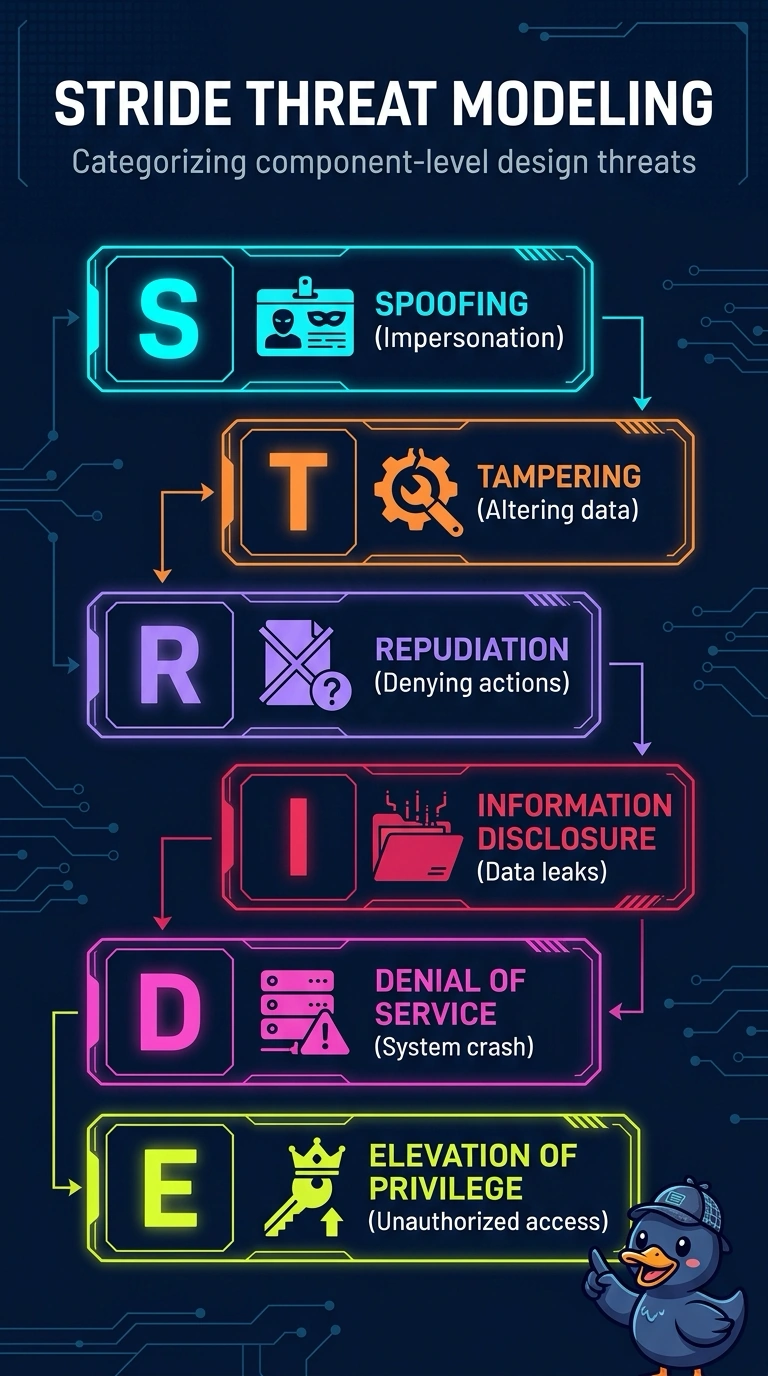
An engineering team is designing a new customer-facing payment API and wants a structured, developer-friendly framework to categorize potential threats like spoofing, tampering, and elevation of privilege against each architectural component. Which threat modeling approach best fits this need?
Select an answer to reveal the explanation.
Short Explanation
When builders design a new API, they need a blueprint checklist that asks how each piece could be tricked or abused. You want a framework tailored to software components, not an intrusion timeline or hunting workflow. Watch out for the trap of picking an operational hunting model when the task is pre-release design review.
Full Explanation
STRIDE for categorizing component-level design threats maps directly to Spoofing, Tampering, Repudiation, Information Disclosure, Denial of Service, and Elevation of Privilege across data-flow diagrams. This structure helps developers systematically evaluate how each API endpoint, data store, and trust boundary could be abused before code reaches production. TaHiTI for intelligence-driven recurring threat hunts is a threat hunting methodology designed to trigger and scope hunts from threat intelligence rather than model software architecture. Cyber Kill Chain for organizing intrusion-lifecycle phases describes the sequential stages of an external attack campaign including reconnaissance, weaponization, and delivery before exploitation instead of categorizing component-level design flaws. Pyramid of Pain for ranking indicator durability against adversaries measures how difficult it is for attackers to replace specific observables, which guides detection engineering rather than application threat modeling. One caveat is that STRIDE identifies potential threat categories well but does not automatically rank business risk without pairing it with impact scoring. As an operational check, walk through the API data-flow diagram with developers and map at least one mitigation to each applicable STRIDE category.