
A healthcare provider's security team wants to build a threat model that maps known adversary behaviors directly to the organization's clinical database servers and identity infrastructure to expose defensive blind spots. Which modeling approach best supports this goal?
Select an answer to reveal the explanation.
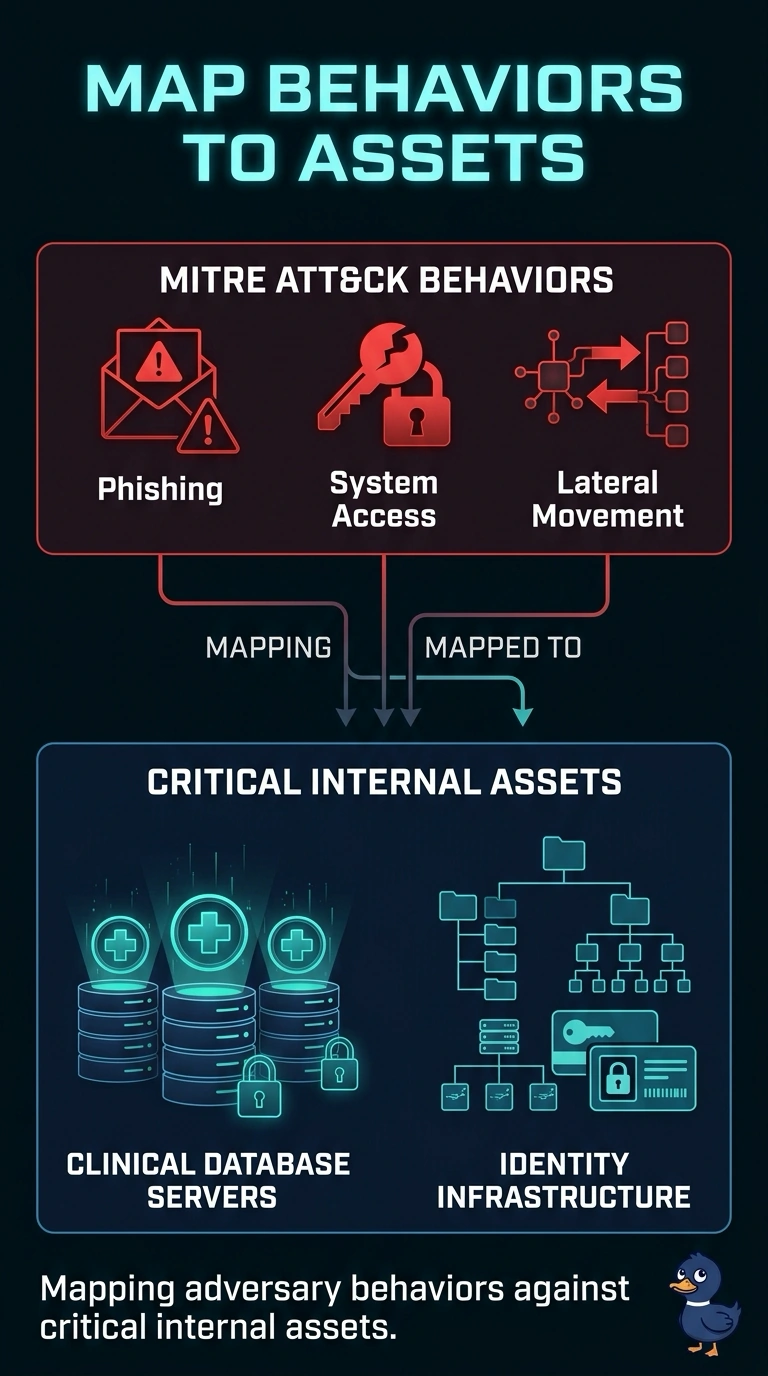
Short Explanation
Threat modeling works best when you connect how attackers actually move to the specific crown jewels you are trying to protect. The trap is mistaking raw firewall counts, uncontextualized severity scores, or unindexed packet archives for a behavior-driven threat model.
Full Explanation
Mapping adversary behaviors in MITRE ATT&CK against critical internal assets is correct because ATT&CK organizes real-world tactics and techniques, allowing defenders to evaluate whether existing telemetry and controls can detect or block each step against high-value systems like clinical databases and identity servers. Cataloging only external perimeter firewall rule counts across branch offices fails because rule volume measures configuration size rather than adversary capabilities or internal lateral movement paths. Ranking vulnerabilities solely by base severity scores without asset context fails because generic scores ignore how an attacker chains multiple behaviors to reach specific internal targets. Archiving raw packet captures indefinitely without mapping them to adversary goals fails because passive storage creates data volume without identifying detection coverage gaps. As a caveat, ATT&CK modeling should be tailored to your actual operating systems, cloud services, and likely threat actors rather than treating every cataloged technique as equally urgent. For an operational check, overlay your current SIEM and endpoint detection rules onto the mapped asset behaviors to highlight high-risk techniques that currently lack telemetry coverage.