
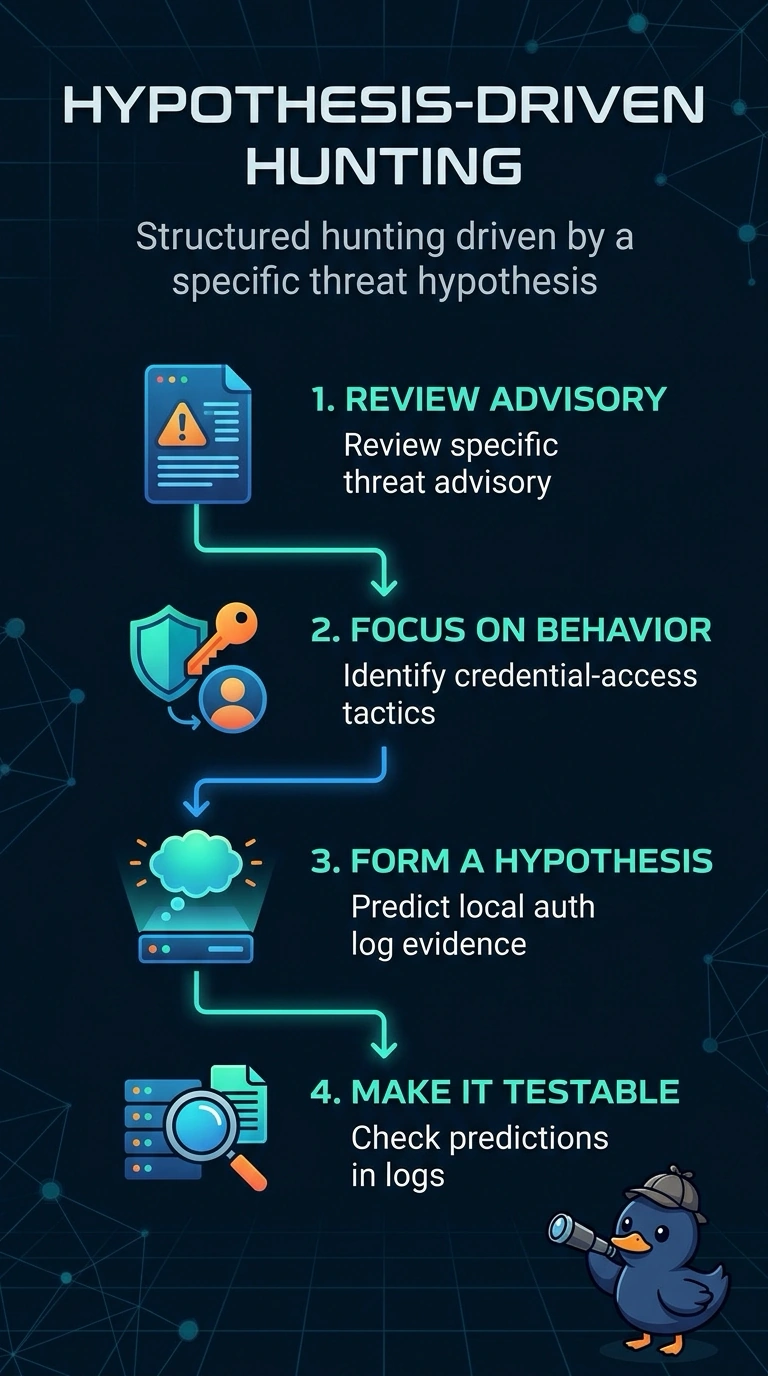
A threat hunter reviews an industry advisory describing a specific credential-access tactic and formulates a testable assumption about how that behavior would appear in local authentication logs. Which hunting approach is the analyst using?
Select an answer to reveal the explanation.
Short Explanation
Think of structured hunting like fishing with specific bait in a spot where you know the fish feed. When you start with a clear adversary behavior and test how it looks in your logs, you are running a structured hunt. The trap is calling every log search unstructured just because no alert fired first.
Full Explanation
Structured hunting driven by a specific threat hypothesis begins with intelligence about adversary tactics and techniques, then defines a falsifiable assumption to test against relevant telemetry. Unstructured hunting based on broad anomaly exploration in raw logs starts without a predefined adversary behavior, relying instead on statistical outliers, frequency stacking, or visual exploration to spot oddities. Reactive triage triggered by high-severity endpoint antivirus alerts responds to automated detections rather than proactively searching for unflagged attacker activity. Compliance auditing focused on verifying password policy length checks static configuration standards rather than hunting for active or historical adversary behavior. As a caveat, even a well-formed structured hypothesis can fail if the required authentication fields are not logged or retained long enough. As an operational check, document your hypothesis statement, expected log fields, and pass or fail criteria before executing the search in your SIEM.