
An enterprise configures its SIEM to alert only when a single workstation generates more than twenty failed authentication events within five minutes, yet an attacker successfully compromises multiple accounts without triggering an alert. Why did the detection tool miss this activity?
Select an answer to reveal the explanation.
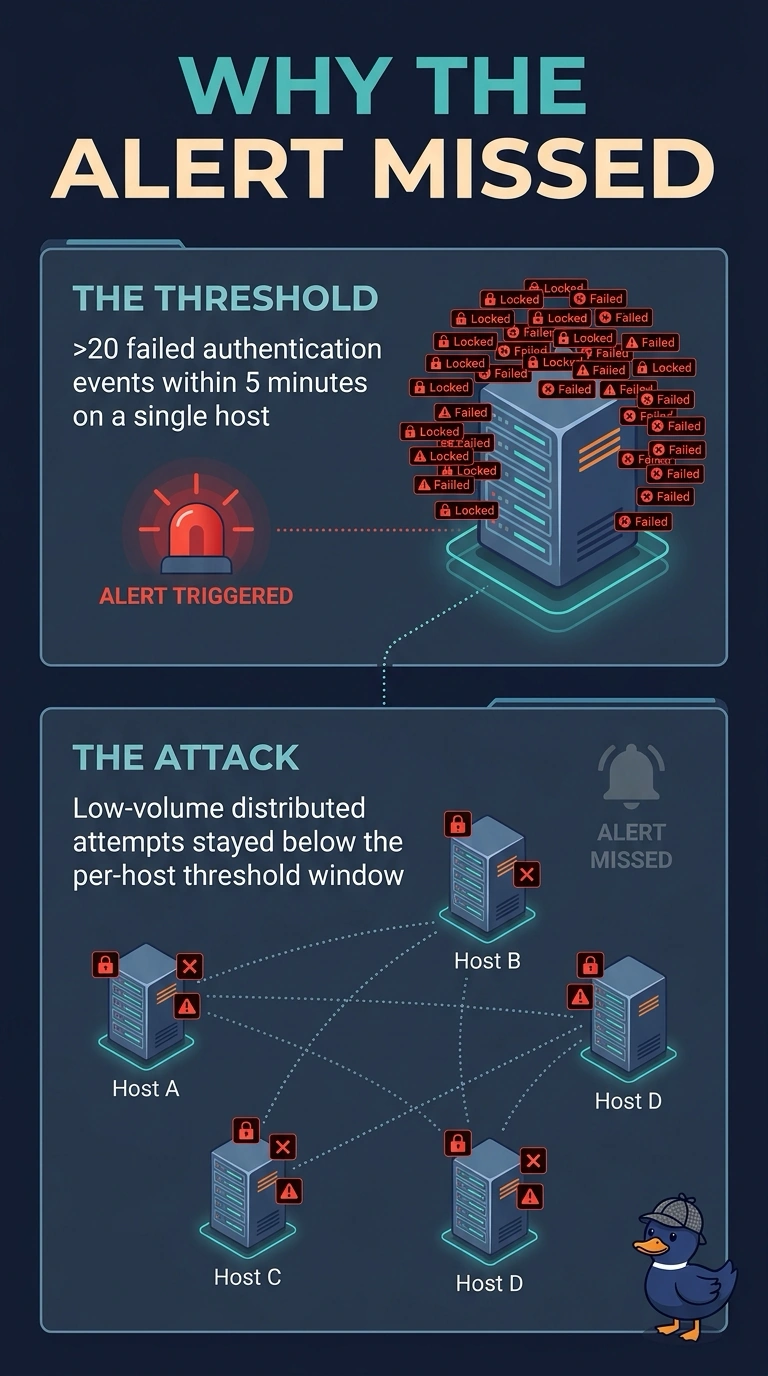
Short Explanation
Imagine a pickpocket taking one dollar from twenty different wallets instead of twenty dollars from one—no single victim notices right away. If your SIEM only counts failures per host, distributed attacks slip right under the wire.
Full Explanation
Per-host threshold rules evaluate event counts within a narrow scope and time window, which adversaries exploit by spreading authentication attempts slowly across many accounts or source hosts. Because Low-volume distributed attempts stayed below the per-host threshold window, each individual endpoint appeared normal even while credential guessing progressed across the enterprise. Choosing to claim The SIEM automatically suppresses all authentication alerts during business hours describes an unverified misconfiguration rather than the architectural limitation of per-host thresholds. Choosing to state Endpoint agents cannot record failed login events on domain-joined systems is incorrect because domain controllers and endpoints routinely log failed authentication attempts. Choosing to claim Symmetric network routing prevented the domain controller from logging failures confuses network traffic paths with identity audit logging on the authentication server. As a caveat, simply lowering per-host thresholds too far creates severe alert fatigue from normal user typos. Operationally, aggregate failed authentication events by target account and source subnet across longer time windows in your SIEM, and verify that distributed low-count sweeps trigger a combined correlation alert.