
A regional bank's SOC notices that its supervised machine learning alert classifier generates increasing false positives each quarter as new cloud applications launch, even though the model performed accurately at deployment. Which action best addresses this degradation?
Select an answer to reveal the explanation.
Short Explanation
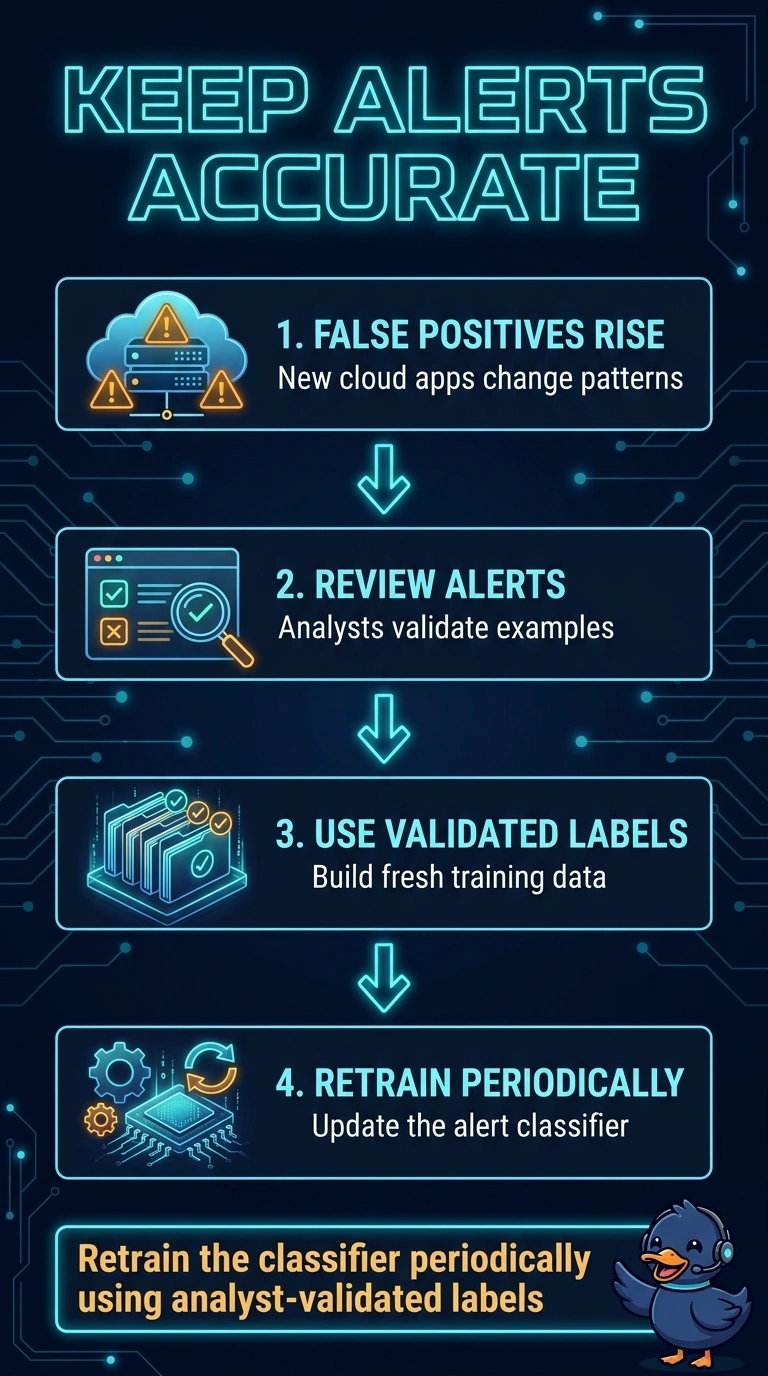
Think of a SOC machine learning model like a map of a growing city—if you never update it when new roads open, it will keep flagging normal traffic as wrong turns. The trap is cranking up thresholds or shutting off features, which hides real threats alongside the noise. Periodically retraining your classifier with fresh, analyst-verified dispositions keeps its baseline aligned with your evolving environment.
Full Explanation
Production networks constantly evolve as organizations adopt new cloud services, update software, and shift user workflows, causing a phenomenon known as concept drift. To maintain accuracy, a security team must Retrain the classifier periodically using recent analyst-validated labels so the supervised model learns legitimate new patterns alongside emerging threats. Simply choosing to Increase the global alert threshold so only maximum-confidence scores fire masks symptoms without fixing the underlying drift and risks dropping genuine low-and-slow intrusions below the reporting line. Attempting to Disable behavioral features and rely exclusively on static hash lookups strips away the ability to catch novel or living-off-the-land activity that never writes a known malicious file. Choosing to Train the model once on synthetic lab traffic to remove local noise bias ignores the unique telemetry distribution of the bank's actual production environment, which only worsens misclassification. As an important caveat, verify that analyst-validated labels are peer-reviewed before retraining so mislabeled tickets do not poison the model. As an operational check, track precision and recall trends on a held-out validation dataset after each retraining cycle to confirm false positives drop without sacrificing detection coverage.