
A SOC deploys a User and Entity Behavior Analytics model that flags software developers for running administrative scripts and accessing code servers, even though that behavior is normal for their role. What modeling mistake caused these false positives?
Select an answer to reveal the explanation.
Short Explanation
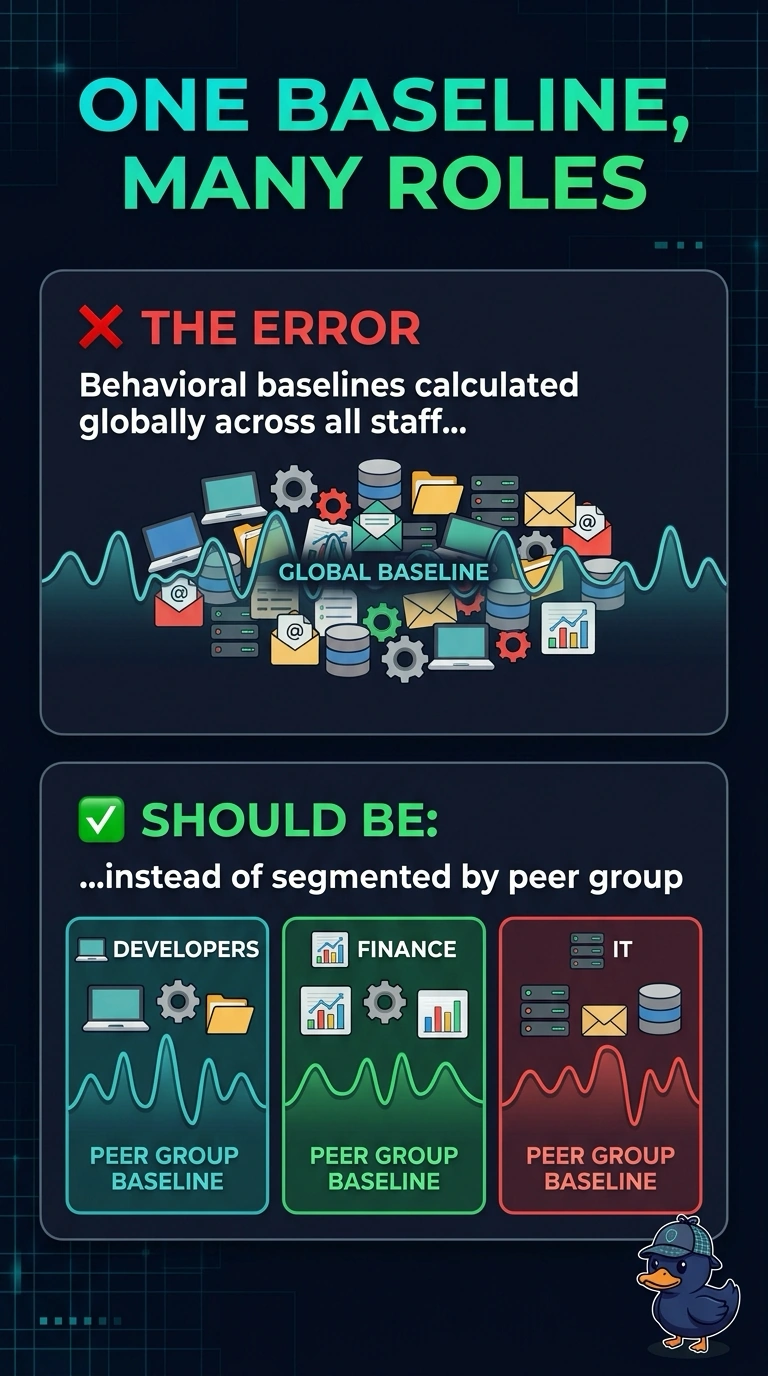
Comparing a software developer's daily terminal activity to an accounting clerk's workload is like flagging a delivery driver for putting too many miles on a truck. You have to compare people against peers who do the same job. The trap is blaming data collection when the real issue is an unsegmented baseline.
Full Explanation
Machine learning anomaly detectors rely on accurate reference populations, which fails when Behavioral baselines were calculated globally across all staff instead of segmented by peer group. Because developers routinely invoke scripting interpreters, compilers, and code repositories that non-technical staff never touch, a single organization-wide baseline treats normal engineering work as an outlier. Suggesting that The SOC failed to collect any endpoint process telemetry from developer workstations contradicts the scenario, since the model is actively observing and alerting on those developer scripts. Likewise, The model was configured to ignore all authentication events occurring during business hours would reduce alert volume rather than trigger false positives on daytime engineering tasks. Saying that Analysts enabled supervised signature matching instead of statistical anomaly detection on the platform misidentifies the cause, as peer-group skew is a classic statistical baselining problem rather than a static signature rule. As a caveat, even well-segmented peer groups need periodic review when employees change roles or teams. As an operational check, audit the directory attributes or role tags feeding your UEBA engine to confirm departments and job functions are grouped separately.