
A threat hunter reviews NetFlow records showing an internal finance workstation repeatedly contacting an unfamiliar external IP address over TCP port 443. The exported records contain only the basic five-tuple, timestamps, and counters. Why can the hunter not determine which local application or user initiated the traffic from NetFlow alone?
Select an answer to reveal the explanation.
Short Explanation
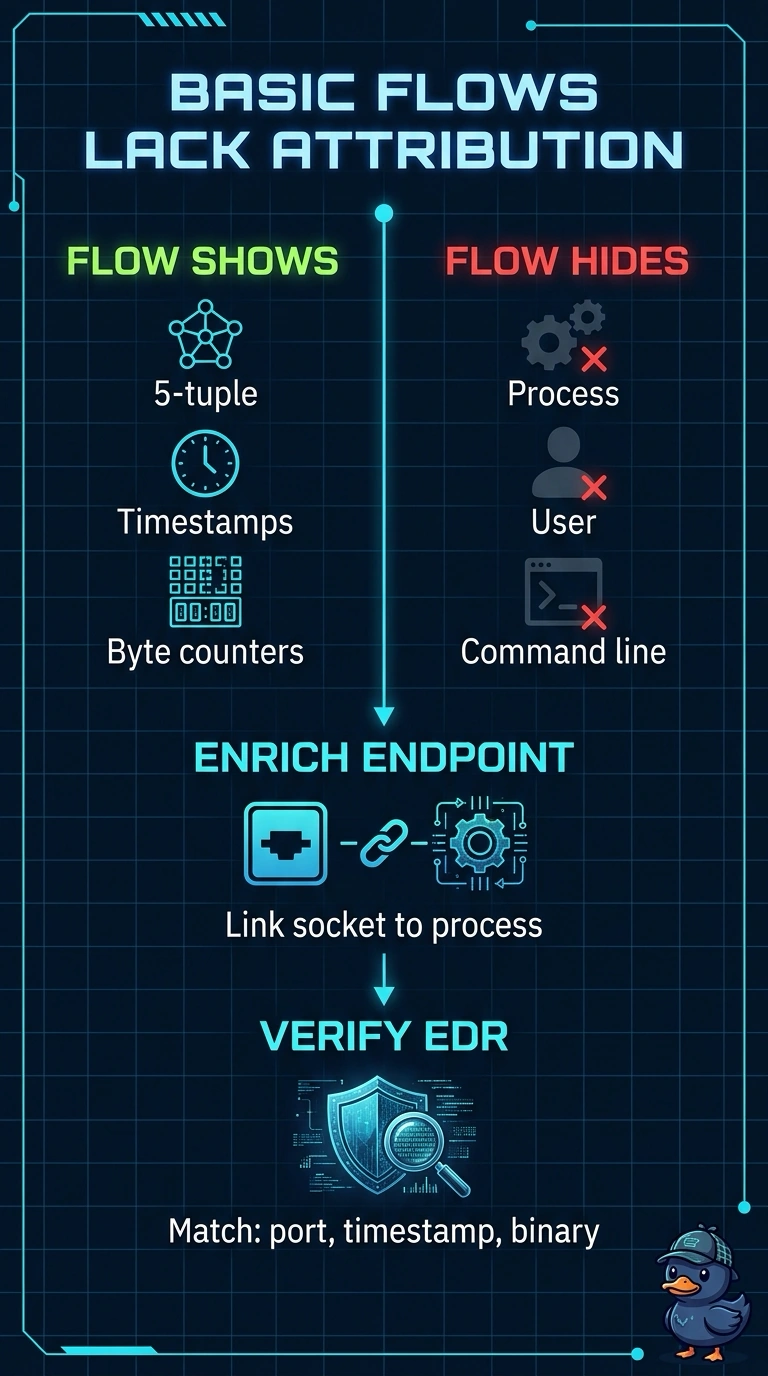
Think of NetFlow like a phone bill that lists the numbers called and call duration, but never tells you who held the handset. The trap is assuming network sensors can see inside the workstation; you still need endpoint telemetry to link that socket to a specific process and user.
Full Explanation
These basic flow records lack endpoint process and user attribution. Basic flow exports do not identify the originating OS process; extended application-aware or endpoint-enriched exports can include additional context. To identify the exact executable, command line, and logged-on account responsible for an outbound socket, you must correlate those flow records with endpoint process-creation and network-connection telemetry. NetFlow records encrypt source and destination IP headers to preserve internal privacy is incorrect because flow collectors require readable IP addresses and ports to summarize sessions. NetFlow sensors automatically drop outbound connections that use TLS encryption on port 443 is wrong since NetFlow records encrypted sessions normally without inspecting their payloads. NetFlow appliances only log inbound connection attempts from external untrusted networks fails because flow exporters track bidirectional or egress traffic across configured interfaces. As a caveat, NAT gateways can obscure the true internal source IP if flow collection occurs only outside the perimeter. For an operational check, query your EDR or host firewall logs for the matching source port and timestamp to pinpoint the initiating binary.