
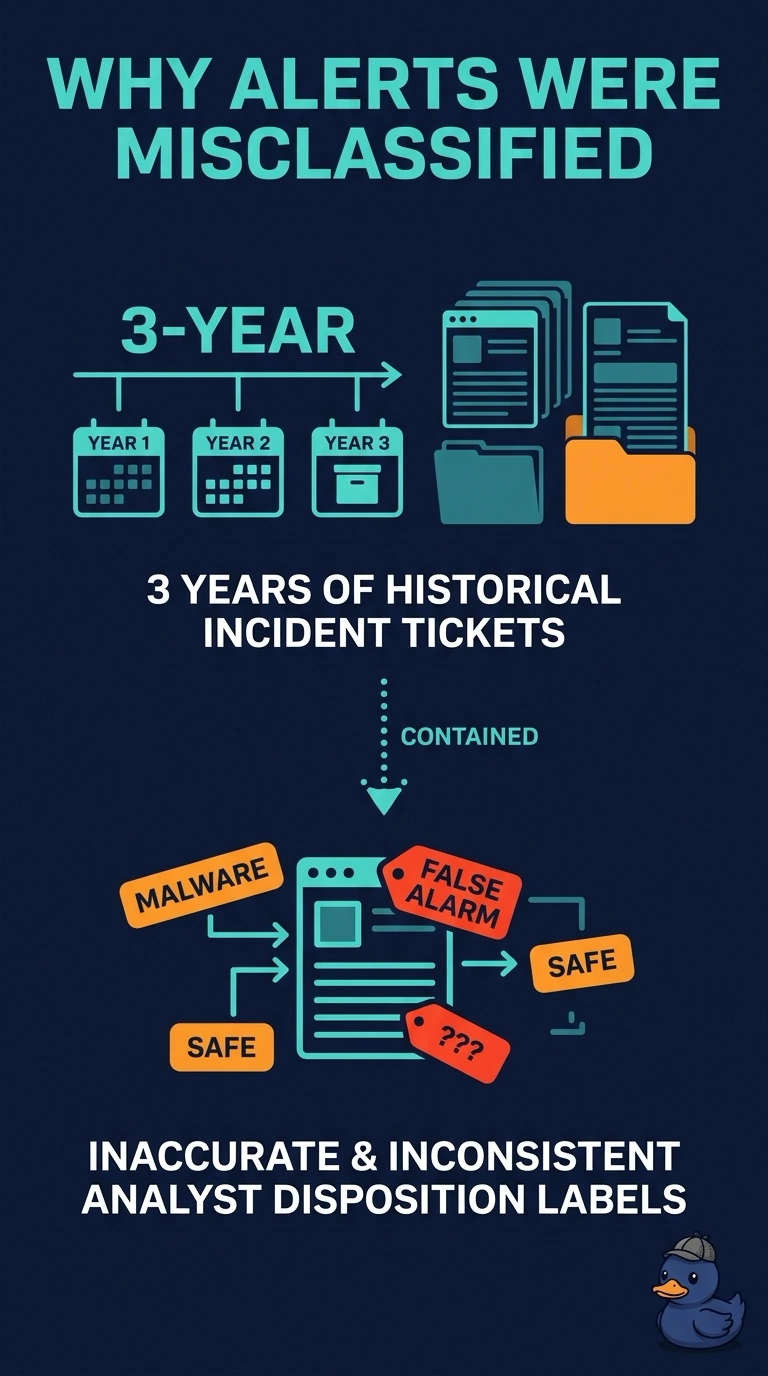
A retail SOC trains a supervised machine learning classifier on three years of historical incident tickets to prioritize endpoint alerts, but the model repeatedly misclassifies benign administrative scripts as critical threats. What training-data issue most likely explains this failure?
Select an answer to reveal the explanation.
Short Explanation
A machine learning model is only as reliable as the teacher grading its homework. If your historical tickets were closed with sloppy or inconsistent labels, the model learns those exact mistakes, and the trap is blaming the algorithm instead of auditing the training data.
Full Explanation
Historical incident tickets contained inconsistent or inaccurate analyst disposition labels directly degrades supervised classifiers because the algorithm learns decision boundaries from those past human tags. When analysts previously marked false positives inconsistently or closed noisy alerts without proper categorization, the model reproduces those errors in production. Claiming that Supervised models cannot process numeric timestamps or process identifiers in endpoint logs is false, as feature engineering routinely encodes structured log attributes. Likewise, Supervised classifiers require zero labeled examples and automatically cluster unlabeled telemetry describes unsupervised clustering rather than supervised learning. Finally, Machine learning models automatically delete benign baseline records during initial ingestion is incorrect because training pipelines preserve labeled benign and malicious samples to learn the distinction. As a SOC caveat, even accurate historical labels become stale when enterprise tooling or attacker techniques shift. As an operational check, sample and re-verify a subset of historical false-positive and true-positive tickets with senior analysts before retraining any supervised detection model.