
A retail enterprise maintains round-the-clock SIEM monitoring and currently shows zero unresolved high-severity alerts. When leadership asks why the security team should still fund proactive threat hunting, which principle best justifies the program?
Select an answer to reveal the explanation.
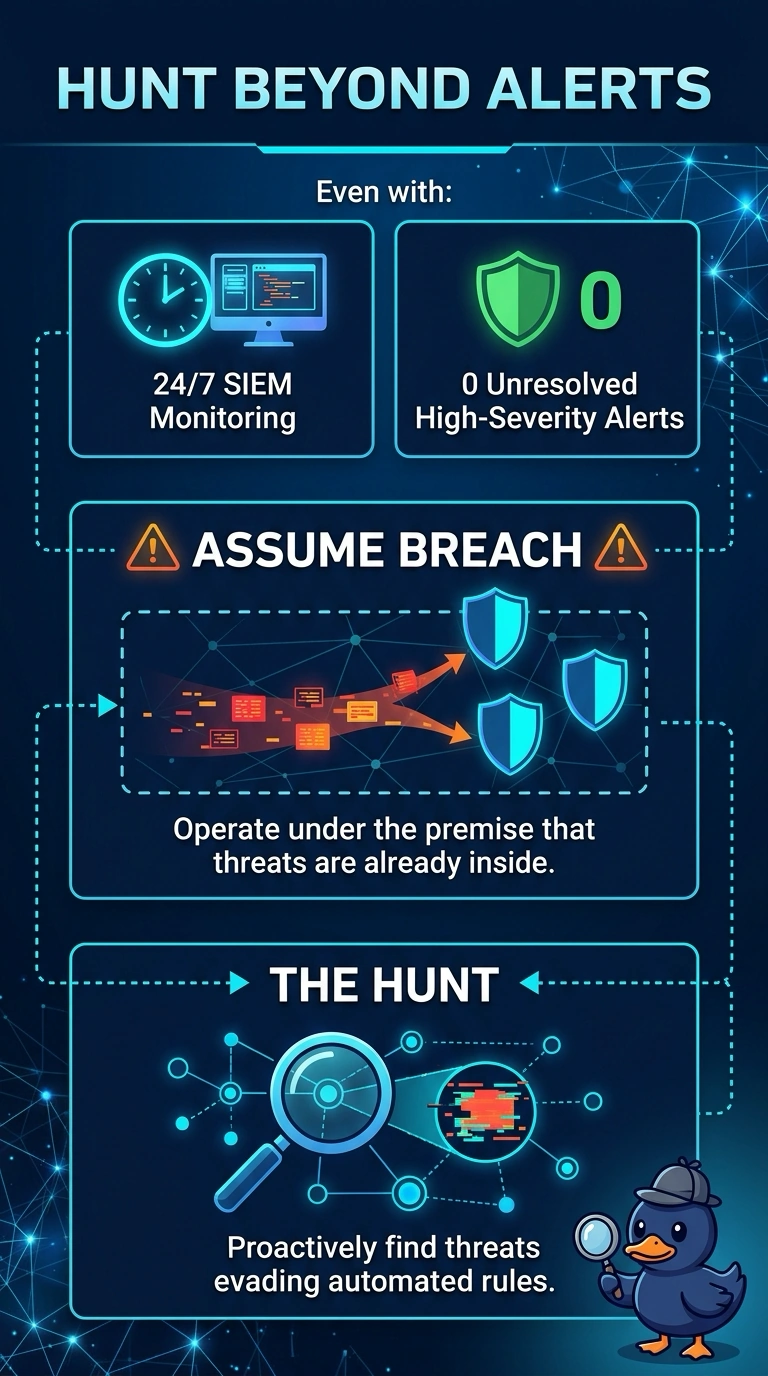
Short Explanation
Think of a quiet alarm panel as a good sign, not a guarantee that your doors are locked. Proactive hunting starts from the idea that determined intruders can slip past automated rules, so waiting for an alert leaves you blind. Do not mistake zero alerts for zero compromise.
Full Explanation
Proactive threat hunting relies on operating under an assumed-breach premise to find threats evading automated rules. Automated SIEM and endpoint detections only catch behaviors that match existing signatures, thresholds, or modeled baselines, whereas skilled adversaries use living-off-the-land techniques and valid credentials to blend into normal traffic. By assuming an intruder may already be present, hunters actively search raw telemetry for subtle anomalies before major impact occurs. Replacing tier-one SOC alert triage teams entirely with automated ticketing workflows fails because hunting complements rather than eliminates reactive triage for known alerts. Guaranteeing zero future security incidents once all endpoint sensors are deployed is unrealistic because no security control provides absolute prevention. Eliminating the need for centralized log retention across branch office networks would actually cripple hunting, which depends on historical telemetry. As a practical caveat, hunting requires clear scoping so analysts do not chase benign noise without hypotheses. For an operational check, review recent incidents to see how many began with behaviors that existing alert rules did not flag.