
A threat hunter at a logistics firm reviews an intelligence brief that pairs static file hashes with descriptions of how an adversary abuses built-in administrative tools during execution. Why should the hunter prioritize Indicators of Attack over static Indicators of Compromise when scoping the hunt?
Select an answer to reveal the explanation.
Short Explanation
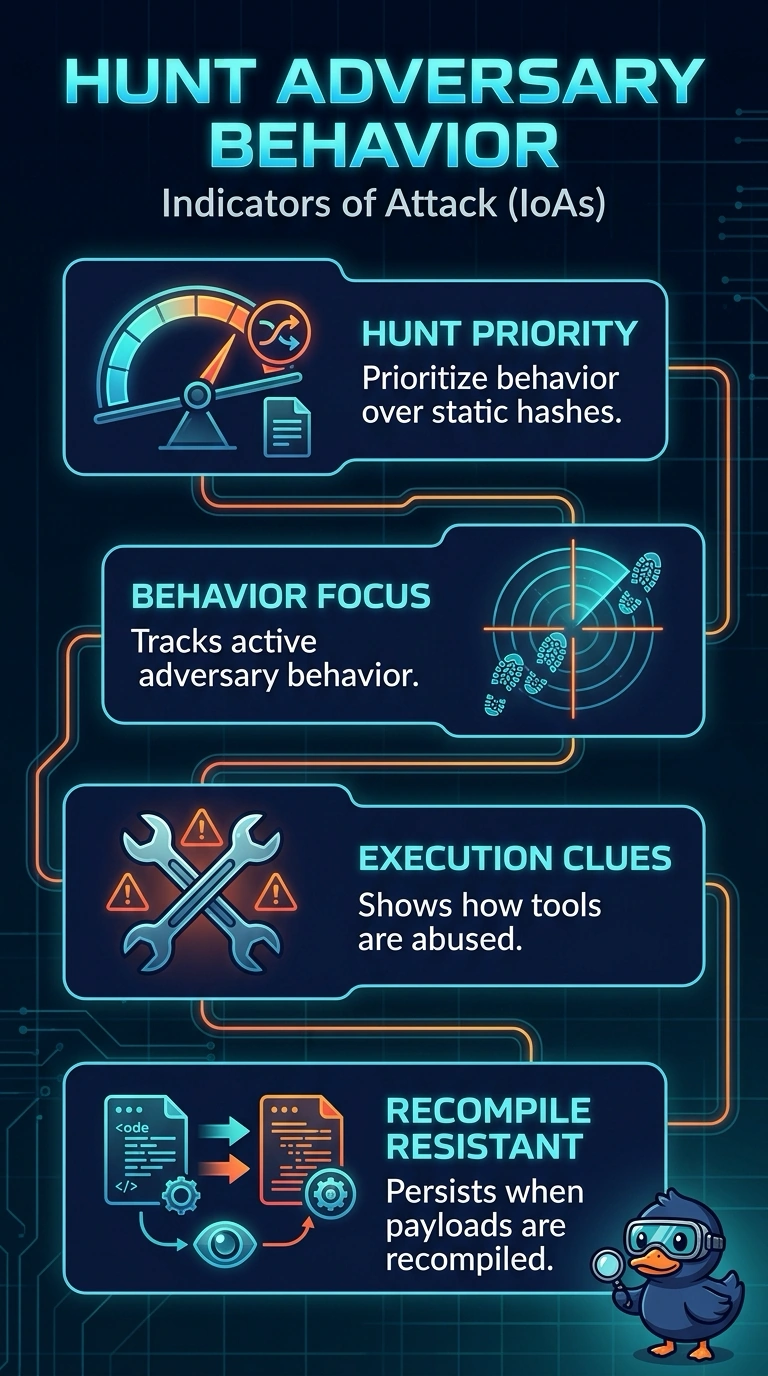
Think of static hashes like a suspect's temporary license plate, whereas behavioral patterns are how they drive. Focusing on Indicators of Attack helps you catch intruders who swap payloads rapidly, while the common trap is chasing brittle hashes that attackers recompile before your query even finishes.
Full Explanation
Indicators of Attack capture active adversary behaviors that persist even when payloads are recompiled, making them far more durable for proactive threat hunting than atomic artifacts. Because attackers routinely modify binaries, rotate domains, and use built-in operating system utilities, behavioral sequences remain visible in process and authentication telemetry across campaigns. By contrast, Static indicators automatically trigger SIEM blocks without requiring analyst tuning is incorrect because feeds require baseline validation and tuning to avoid false positives. Static indicators only apply to external perimeter firewalls and cannot be queried in endpoint logs is also wrong, since hashes and registry paths are routinely searched across host telemetry. Likewise, Indicators of Attack replace the need for centralized endpoint telemetry during an investigation fails because behavioral hunting depends directly on rich host and network logs to observe execution chains. As an operational caveat, behavioral queries can match legitimate administrative scripts if baselines are poorly understood. For an operational check, test each behavioral hunt query against thirty days of historical endpoint logs to verify benign administrative noise before scheduling recurring runs.