
A vendor demonstrates a machine learning intrusion classifier that achieves 99.9% overall accuracy on a dataset where 99.9% of network flows are benign and only 0.1% are malicious. Why should a SOC analyst view this accuracy metric with skepticism?
Select an answer to reveal the explanation.
Short Explanation
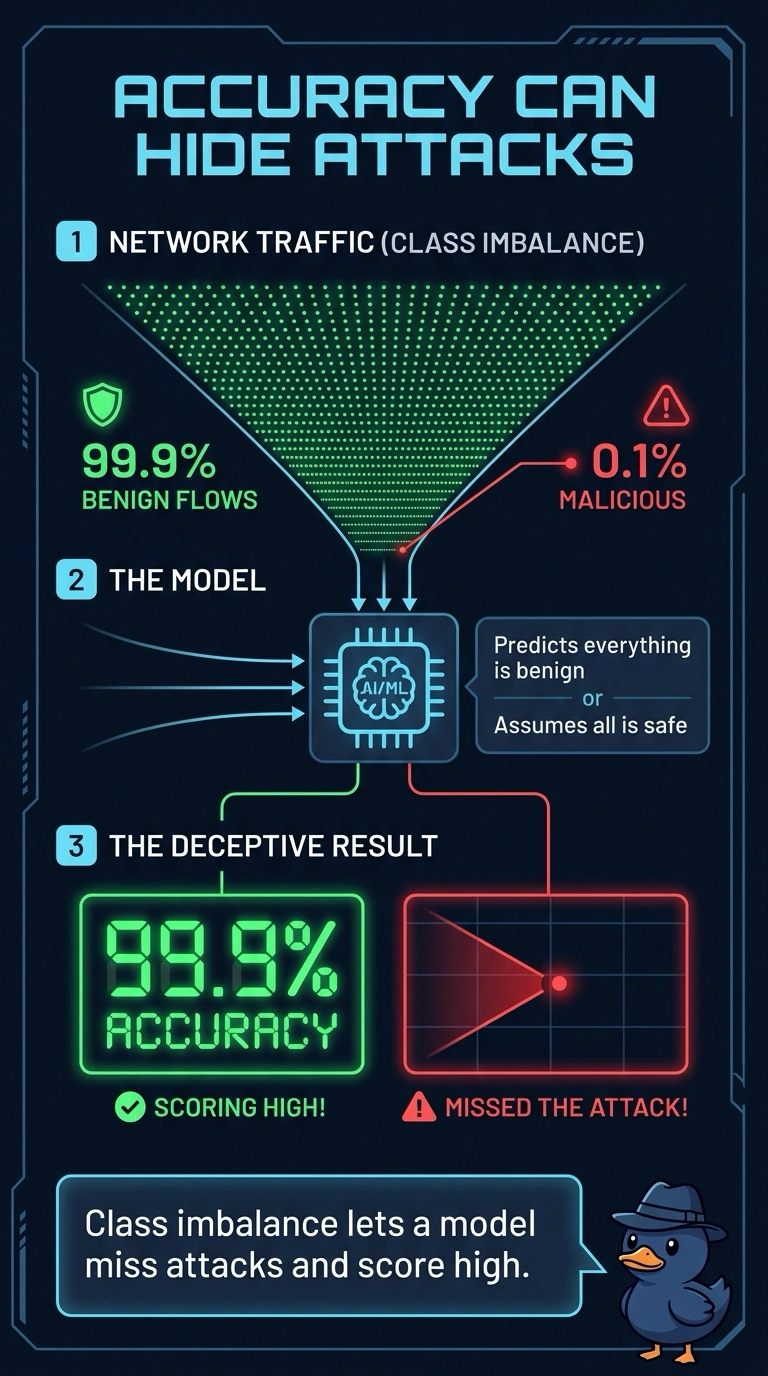
A classifier that simply guesses 'normal' on every single flow can look like a genius on paper while letting every real attack walk right past your SOC. The trap is trusting headline accuracy on heavily imbalanced security data instead of checking precision and recall.
Full Explanation
Class imbalance lets a model miss attacks and score high because in a dataset that is 99.9% benign, a trivial classifier that labels every single flow as benign automatically achieves 99.9% accuracy while detecting zero intrusions. Machine learning models cannot process network flow metadata is false because flow attributes such as byte counts, durations, and ports are routinely used as model features. High overall accuracy guarantees zero false-positive alerts is incorrect because accuracy combines both true negatives and true positives, and a model with high accuracy can still generate unacceptable false-positive volumes in high-throughput networks. Supervised classifiers require no labeled training datasets is also false because supervised learning explicitly depends on labeled examples to learn decision boundaries. As a caveat, even balanced evaluation metrics require realistic local telemetry because lab datasets rarely reflect enterprise traffic diversity. As an operational check, evaluate any SOC machine learning detector using precision, recall, F1 score, and false-positive rate per day on representative local data.