
A logistics enterprise deploys an advanced endpoint detection and response platform across all corporate laptops and servers, yet an intruder maintains a foothold on a network-attached building controller for months without raising an EDR alert. What detection tool limitation does this illustrate?
Select an answer to reveal the explanation.
Short Explanation
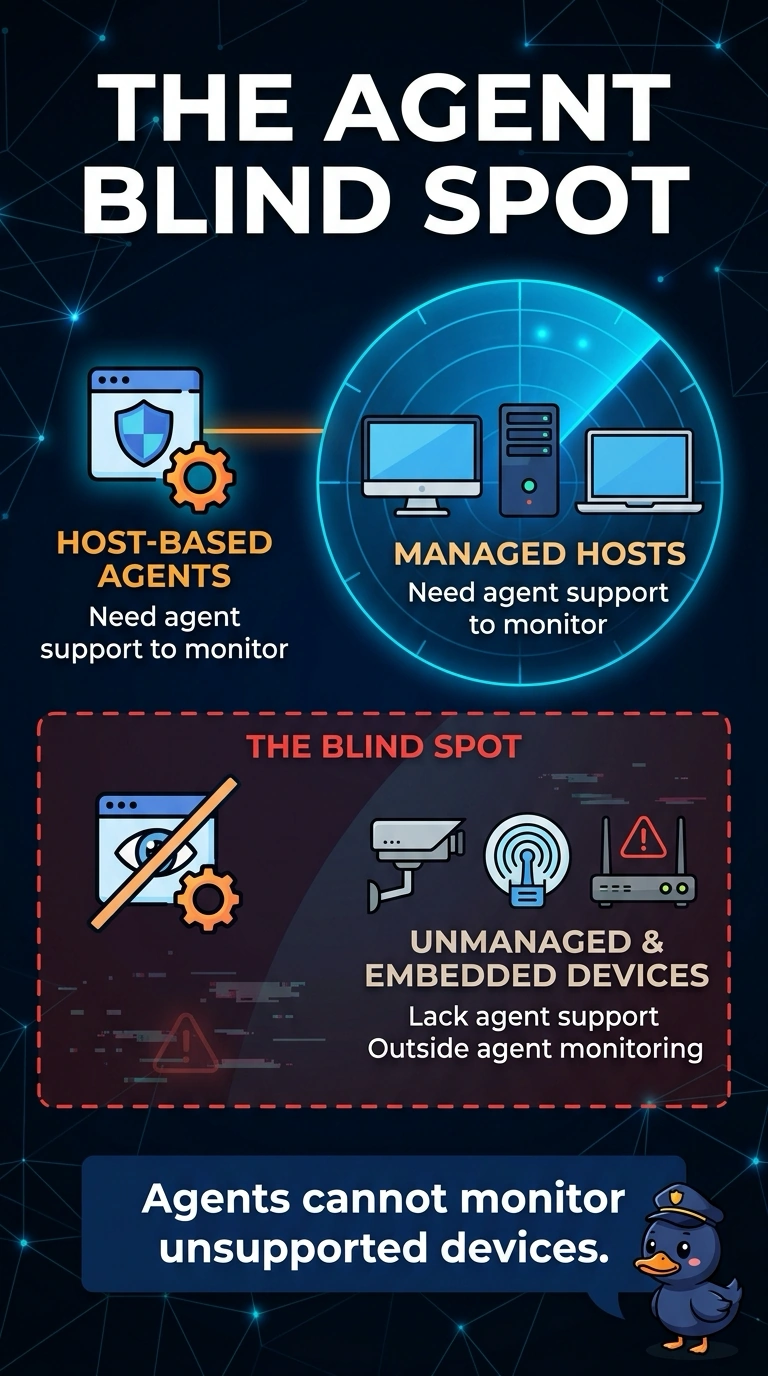
An EDR agent is a fantastic guard dog, but it can only watch the buildings it is allowed to enter—if an appliance cannot run the agent, you are flying blind on that device. The trap is assuming 100% laptop coverage equals 100% network coverage, leaving your unmanaged hardware wide open.
Full Explanation
Every security sensor has architectural boundaries that adversaries deliberately exploit to hide persistence. Host-based agents cannot monitor unmanaged embedded devices that lack agent support illustrates a fundamental limitation of endpoint detection tools: proprietary operational technology, building controllers, and embedded appliances typically run closed firmware that cannot host third-party EDR agents, leaving the endpoint platform completely blind to processes executing on those devices. EDR agents automatically disable themselves whenever network latency rises is incorrect because agents continue local monitoring and buffer telemetry even during network slowdowns. Building controllers always encrypt their internal memory against any network scan is false because embedded controllers rarely encrypt runtime memory, and the core issue is the absence of a host agent rather than memory encryption. EDR platforms cannot inspect process activity on corporate Windows servers is wrong because standard server operating systems are primary targets for EDR deployment. As a caveat, network-based flow monitoring and passive protocol analysis can compensate for agentless devices. For an operational check, compare your asset-discovery inventory against your EDR console to identify unmanaged, agentless devices and place them under dedicated network monitoring.