
A regional utility configures its SIEM correlation rules with short sliding time windows to conserve memory and reduce false positives, yet an intruder enumerates internal accounts over several weeks without triggering an alert. Which detection tool limitation explains why the SIEM missed this activity?
Select an answer to reveal the explanation.
Short Explanation
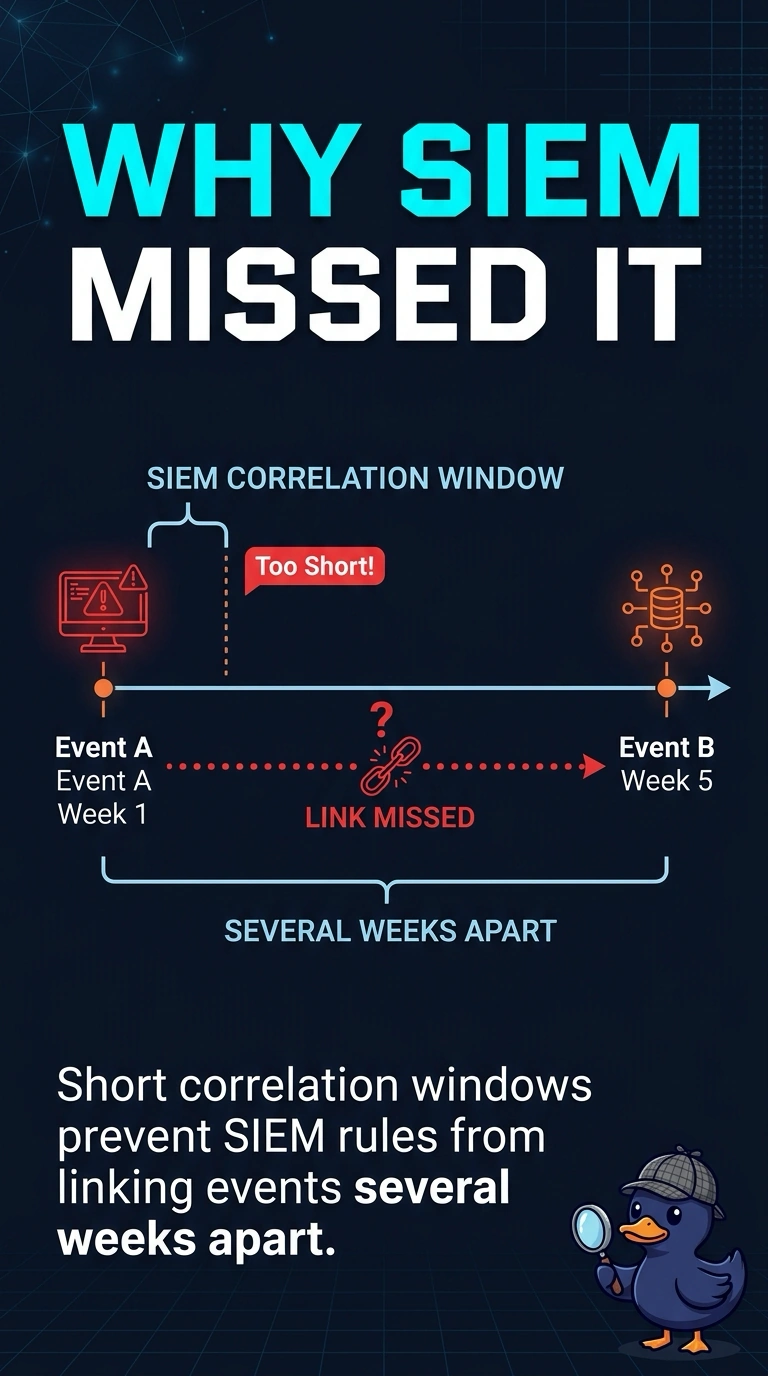
Think of a short SIEM correlation window like a security camera that only remembers the last five minutes—if an intruder takes one step per hour, you never see the whole walk. The trap is blaming log storage or agent coverage when the real culprit is a narrow time window that lets patient attackers slip right between rule evaluations.
Full Explanation
SIEM correlation rules evaluate incoming events within bounded memory buffers so alerts fire quickly without exhausting compute resources. Short correlation windows prevent SIEM rules from linking individual events that occur too far apart in time explains why patient, low-and-slow enumeration across weeks never crosses the rule threshold. SIEM correlation engines automatically discard low-severity authentication events before storing them in long-term indexes is incorrect because SIEMs retain ingested logs according to retention policies even when real-time correlation rules do not fire. SIEM platforms cannot correlate log entries unless all source systems run identical endpoint detection agents is false because SIEMs normalize and correlate heterogeneous logs from firewalls, identity providers, and servers without requiring uniform agents. SIEM log parsers strip timestamps from authentication records whenever external threat feeds are enabled is wrong because parsers preserve event timestamps for timeline reconstruction regardless of threat intelligence enrichment. As a caveat, simply widening real-time correlation windows to weeks can degrade SIEM performance or spike memory usage. For an operational check, run scheduled historical search queries or long-horizon statistical aggregations over archived authentication logs to surface slow trends.