
A manufacturing enterprise relies primarily on network intrusion detection sensors at subnet boundaries, yet an intruder escalates privileges locally on a server without raising an alert. What detection tool limit explains this miss?
Select an answer to reveal the explanation.
Short Explanation
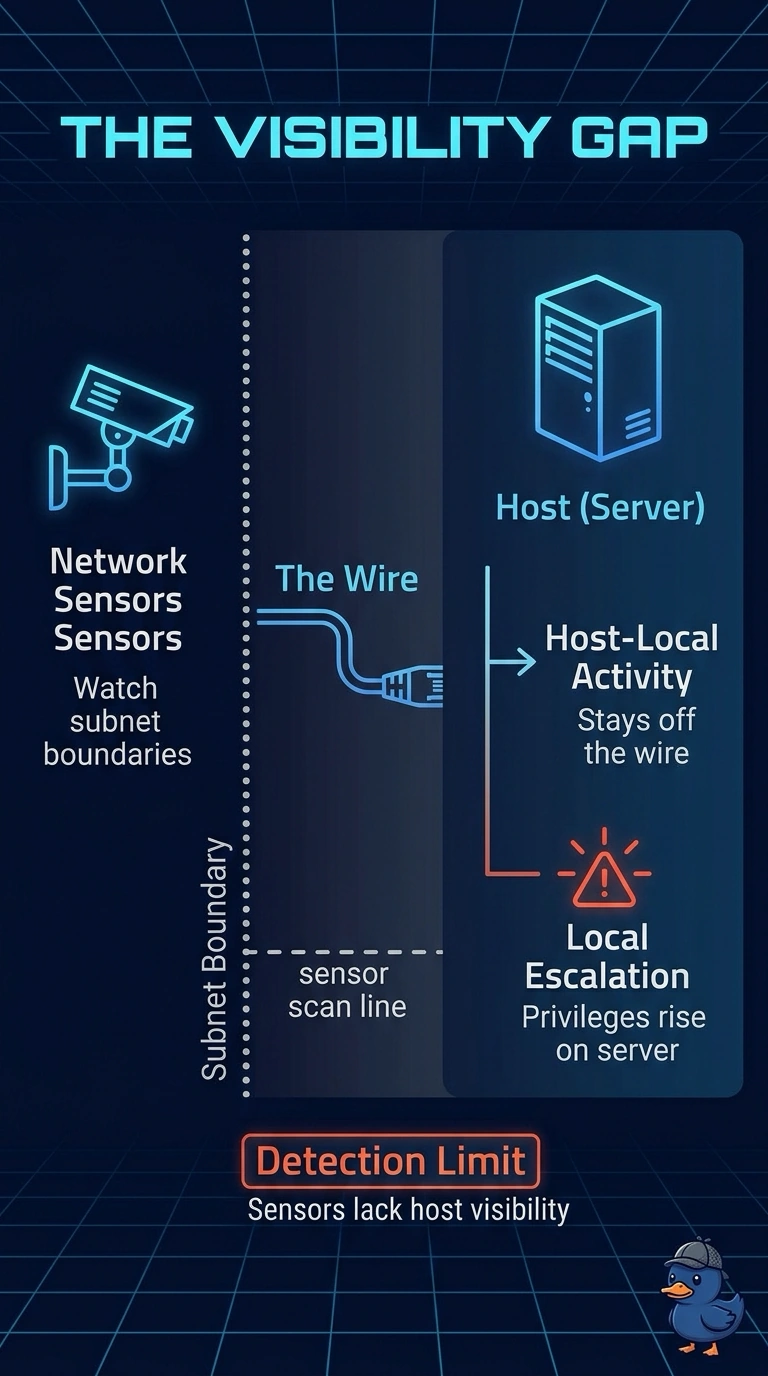
A traffic camera at an intersection cannot see what happens inside a parked car, and your network sensors face that exact same blind spot. The trap is expecting wire-level tools to catch local privilege escalation.
Full Explanation
Recognizing that Network sensors lack visibility into host-local activity that stays off the wire explains why boundary network intrusion detection cannot observe local operating system events. Privilege escalation on a single server often relies on local token manipulation, service misconfigurations, or kernel exploits that execute entirely in host memory and disk without generating network packets across a subnet boundary. Claiming that Network sensors automatically delete alerts generated during weekend shifts invents a false operational behavior rather than a structural visibility boundary. Stating that Network sensors only inspect traffic originating from external cloud service providers misrepresents internal subnet sensors, which examine any traffic traversing their monitored link. Asserting that Network sensors cannot parse standard TCP or UDP packet headers accurately contradicts the core function of network sensors, which are specifically built to decode transport headers. As a caveat, network sensors remain essential for detecting lateral movement and external command-and-control traffic. Perform an operational check by verifying that endpoint detection agents and local OS audit logging are active on critical servers to close host-level blind spots.