
A healthcare SOC director is designing a new detection architecture and must decide how to integrate a machine learning anomaly engine alongside existing SIEM correlation rules. Which approach best reflects the complementary roles of these two technologies?
Select an answer to reveal the explanation.
Short Explanation
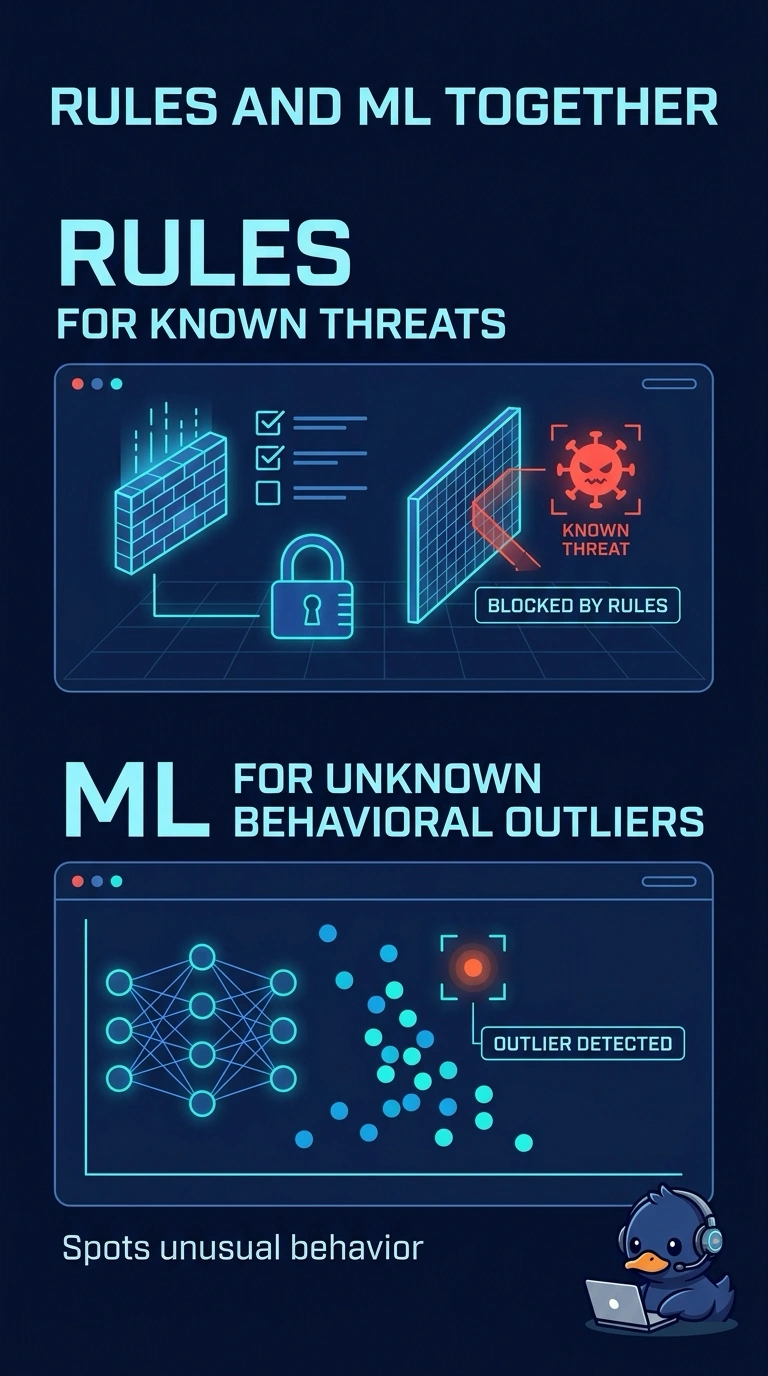
Think of SIEM rules as a wanted poster and machine learning as a neighborhood watch: you need both to protect your network. The trap is assuming AI makes deterministic rules obsolete, when each catches what the other misses.
Full Explanation
Choosing to Use rules for known threats and ML for unknown behavioral outliers gives a SOC layered coverage across both documented attack patterns and novel deviations. Deterministic correlation rules excel at catching well-understood indicators and known adversary techniques with predictable precision, while machine learning establishes behavioral baselines to surface subtle anomalies that lack a prior signature. By contrast, deciding to Replace all static SIEM correlation rules with unsupervised clustering abandons reliable, low-latency detection for known malware and policy violations in favor of probabilistic scoring that requires analyst triage. Similarly, choosing to Train the ML engine exclusively on blocked perimeter firewall denies starves the model of internal east-west, identity, and endpoint context where post-compromise activity unfolds. Finally, opting to Disable ML alerting whenever rule-based signatures match zero events defeats the core purpose of anomaly detection, because novel intrusions often leave known signatures silent. As an operational caveat, machine learning models still require periodic baseline tuning as legitimate clinical workflows change. Perform a quarterly operational check by reviewing whether ML alerts uncover new telemetry gaps that can be codified into deterministic SIEM rules.