
A threat intelligence analyst reviews two vendor advisories on the same ransomware campaign: one lists only fifty file hashes, while the other documents the adversary's credential-access and lateral-movement methods. Why is the second advisory more durable for threat hunting?
Select an answer to reveal the explanation.
Short Explanation
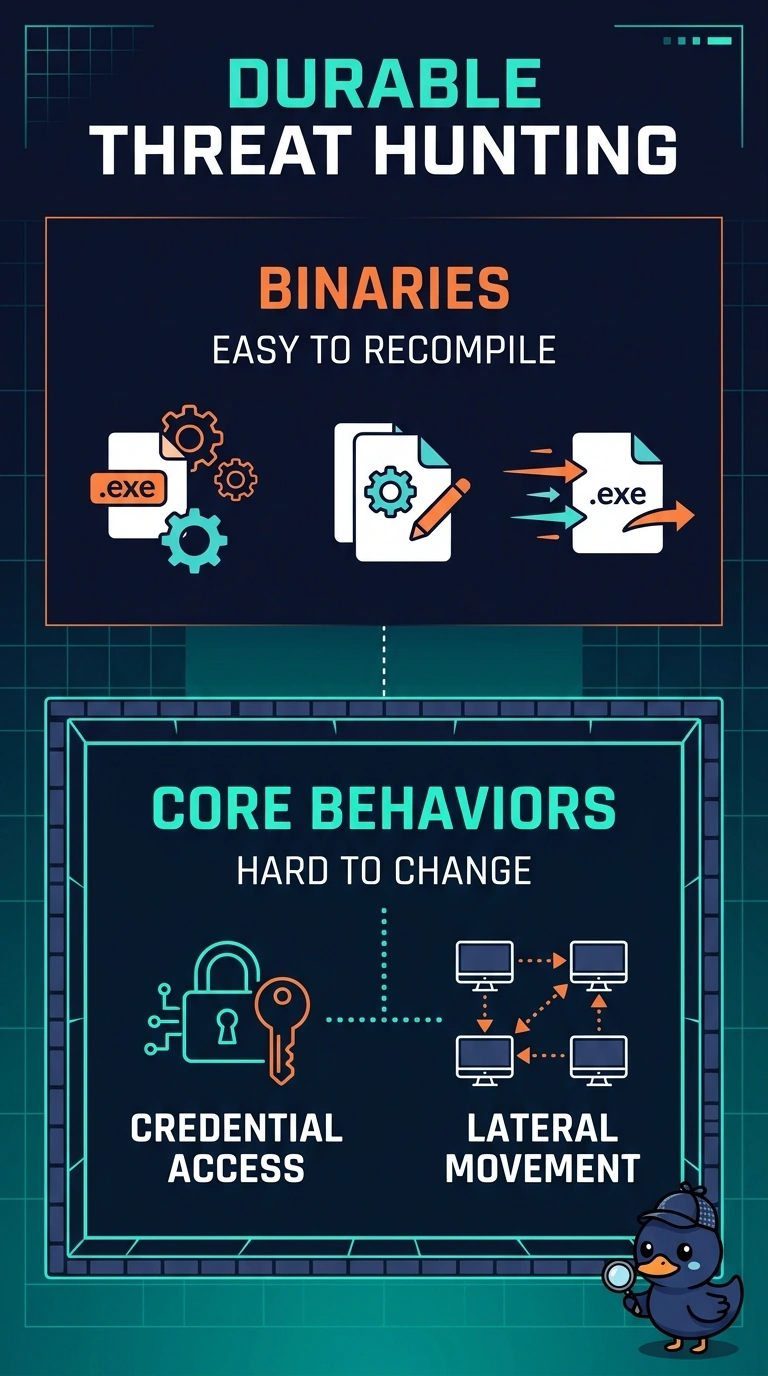
Chasing file hashes is like trying to catch a burglar by memorizing yesterday's outfit—one jacket swap and your search is obsolete. Focus on how the intruder breaks in, because changing core habits is much harder.
Full Explanation
The Pyramid of Pain illustrates that hash values sit at the very bottom because attackers can recompile binaries easily but struggle to change core behaviors without retooling their entire operational playbook. Documenting credential-access and lateral-movement methods equips threat hunters to build detections around invariant tactics, techniques, and procedures that persist across payload variants. File hashes require complex behavioral analytics before they can be searched is backwards; hashes are simple exact-match lookups, whereas behavioral detections require correlation logic. Adversary methods cannot be mapped into standard SIEM correlation rules is false because ATT&CK organizes adversary behaviors; Sigma expresses generic detection logic that compatible backends can convert to platform queries. Analysts still select telemetry and implement and validate the detection. Behavioral advisories automatically block malicious payloads at the perimeter confuses intelligence reporting with active inline enforcement controls. As a caveat, behavioral detections take more engineering effort to tune against legitimate administrative activity than simple hash blocks. Operational check: translate one documented credential-access technique from the advisory into a SIEM hunt query and verify it executes cleanly against your endpoint telemetry.