
A regional hospital deploys an unsupervised machine learning tool to detect anomalous lateral movement, training it on thirty days of live network logs without prior threat hunting. Unknown to the team, an adversary was already running nightly data staging during that window. What is the primary risk of this approach?
Select an answer to reveal the explanation.
Short Explanation
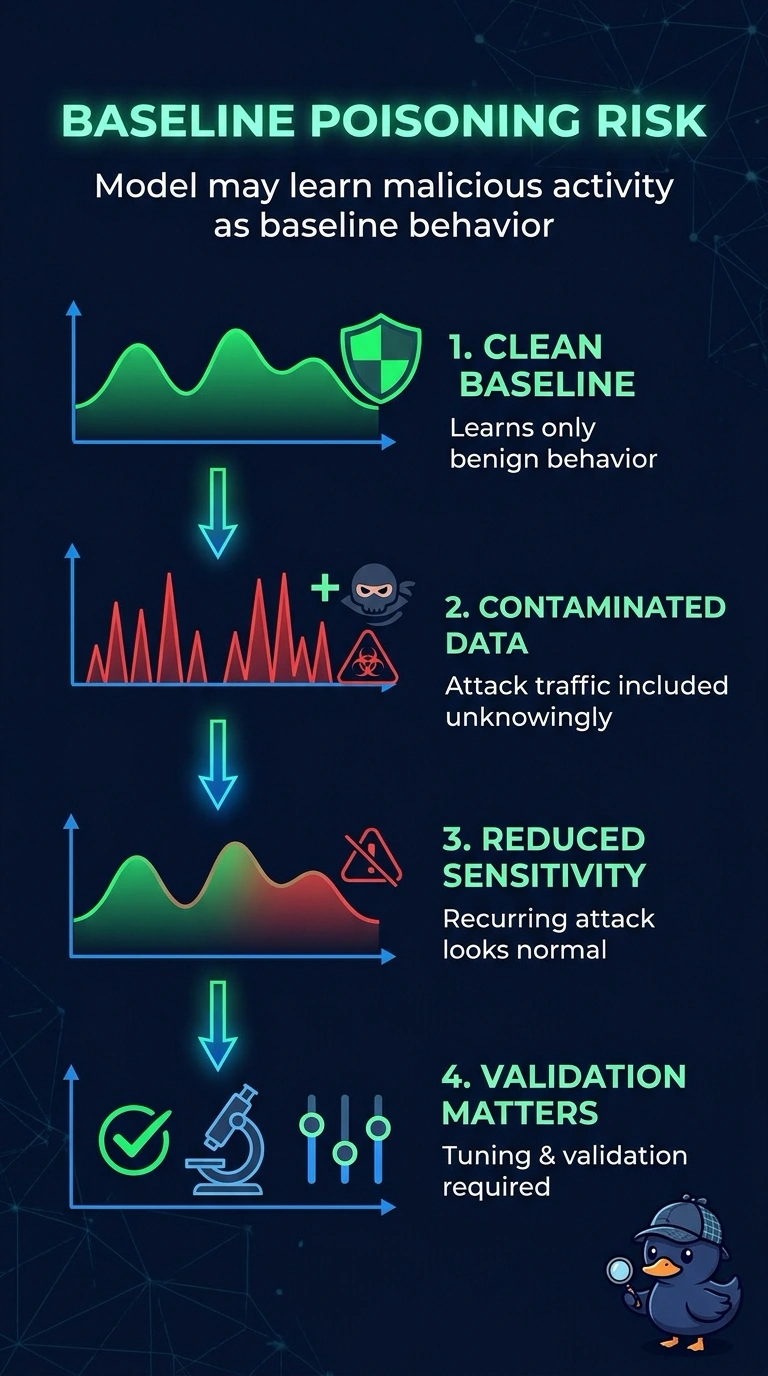
Think of training a security model like calibrating a scale with a brick already sitting on it. If you train an anomaly detector on compromised traffic, the trap is assuming the baseline is clean when the attacker's behavior is actually baked into normal operations.
Full Explanation
An unsupervised machine learning model learns what normal looks like directly from the training dataset, so The model may learn the recurring malicious activity as baseline behavior if an active intrusion is present during baselining. Contaminated training data can reduce sensitivity to the recurring attack; whether it is actually missed depends on the algorithm, features, prevalence, and validation. By contrast, The model will automatically block legitimate clinical applications during peak daytime hours is inaccurate because unsupervised detection models flag deviations from learned patterns rather than arbitrarily blocking established daytime workflows. Similarly, The model will immediately delete historical log archives to conserve local storage confuses anomaly scoring with log retention management. Likewise, The model will convert all unsupervised alerts into static signature rules describes an unrelated capability, as behavioral models evaluate statistical features rather than generating fixed signatures. As a caveat, even a clean baseline drifts over time as hospital systems and workflows evolve, requiring periodic re-evaluation. For an operational check, perform a targeted threat hunt on historical logs before training and validate model outputs against known attack simulations.