
A mid-sized insurance company's security director proposes replacing the proactive threat hunting team with an AI-driven SOC platform to cut staffing costs. Which limitation of machine learning best explains why human threat hunters remain necessary?
Select an answer to reveal the explanation.
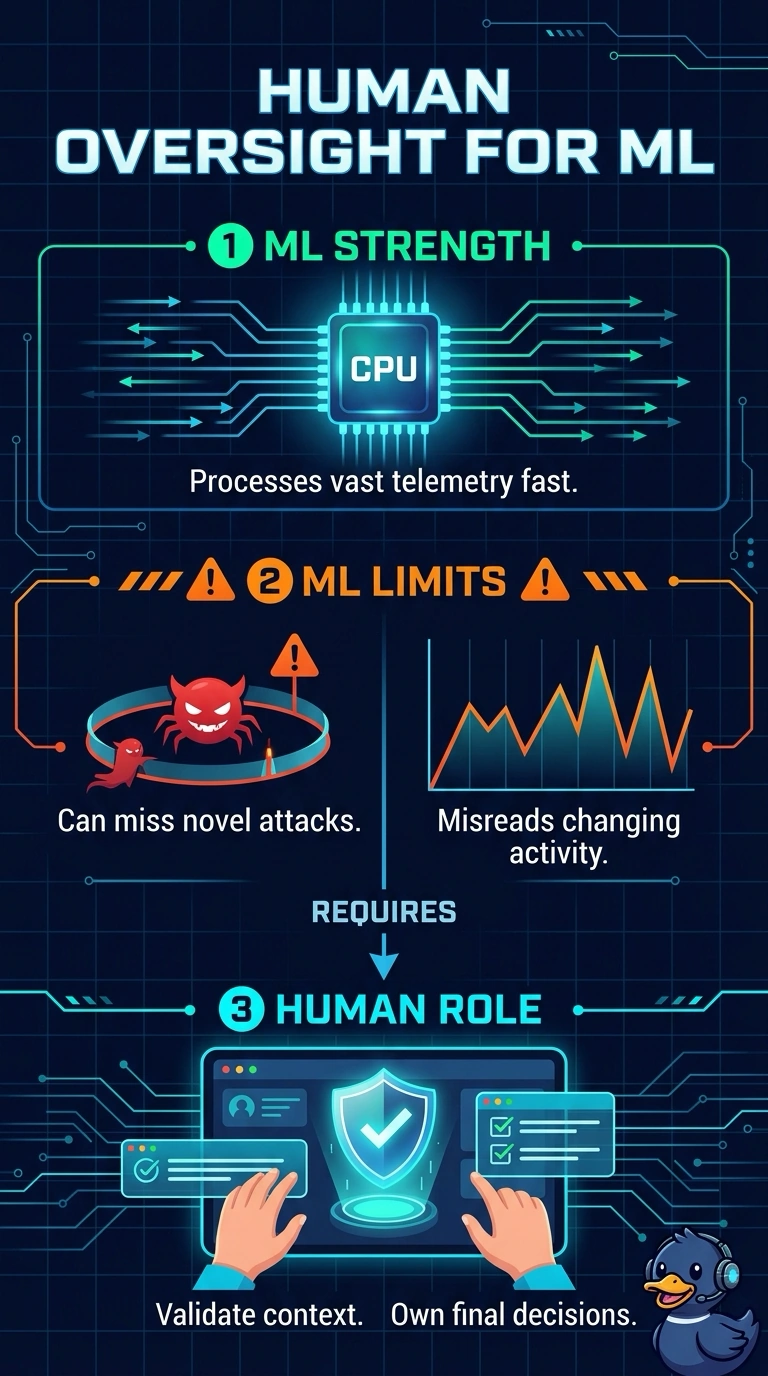
Short Explanation
You can think of ML as tireless triage for your SOC that still needs your judgment on what matters. Models can use supplied context and generalize, but coverage, calibration, and reliability vary; evaluate their limitations and retain appropriate human investigation and decision ownership. You keep hunters because ML can miss attacks or misread changing business activity, requiring contextual validation and accountable human oversight.
Full Explanation
Machine learning excels at statistical detection across massive telemetry, but ML can miss attacks or misread changing business activity, requiring contextual validation and accountable human oversight. Models can use supplied context and generalize, but coverage, calibration, and reliability vary; evaluate their limitations and retain appropriate human investigation and decision ownership. Human hunters supply that ownership by validating alerts against business workflows, crown-jewel priorities, and adversary adaptation, and by checking where drift or calibration gaps create misses. Claims about scale fail because streaming analytics pipelines are designed specifically to process high-volume authentication and network flow records in real time with low latency. Claims about mandatory signature writing confuse statistical learning with traditional signature-based antivirus, which ML was introduced to complement rather than replicate. Claims about inability to correlate across sources overlook standard multi-source feature engineering and centralized data lakes that automatically join endpoint, identity, and network telemetry. As a caveat, even well-tuned models suffer from concept drift when infrastructure changes. Operational check: review recent hunt findings against existing ML alerts to verify where human context bridged detection gaps.