
A healthcare organization relies on perimeter Data Loss Prevention rules to flag sensitive patient records leaving the network, yet an intruder exfiltrates gigabytes of data undetected. Which detection tool limitation most likely explains this blind spot?
Select an answer to reveal the explanation.
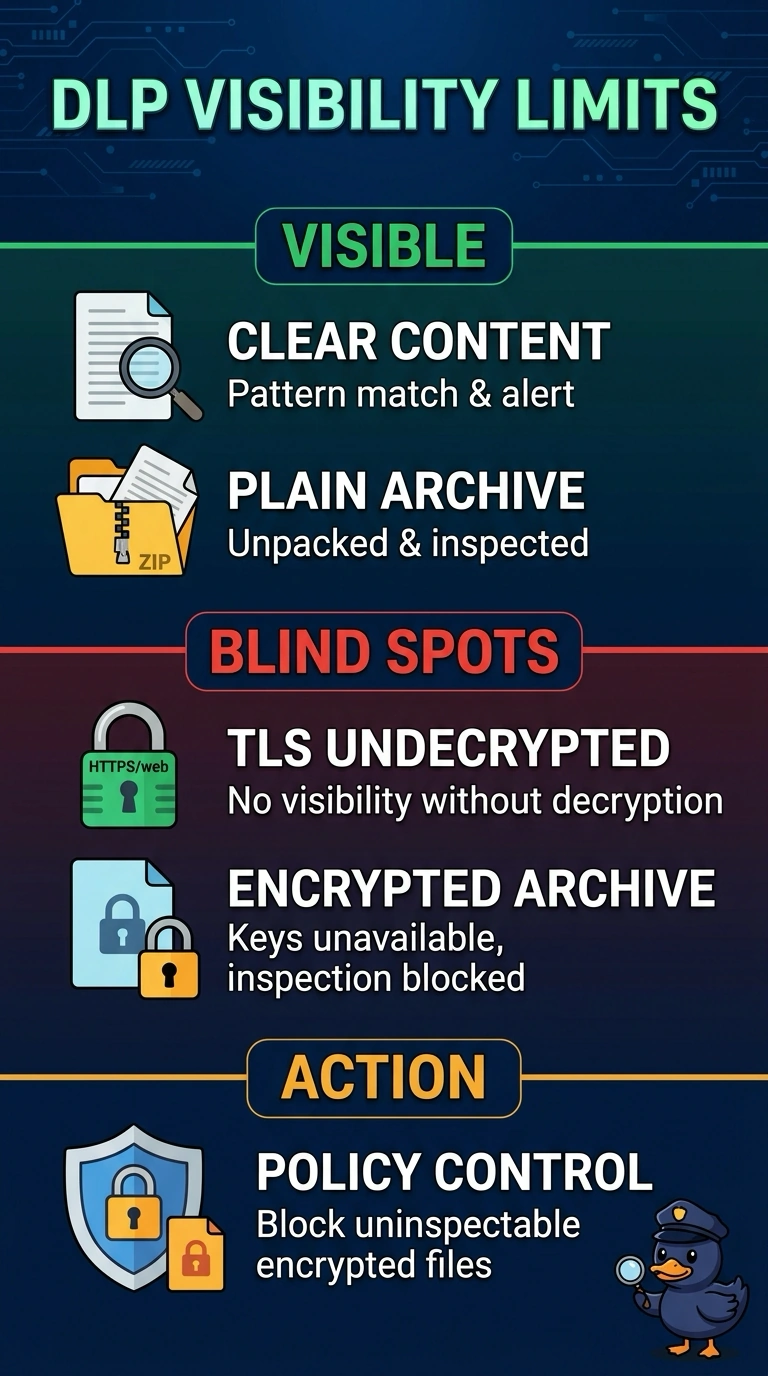
Short Explanation
A perimeter DLP scanner is like a security guard checking open envelopes—if someone locks the data inside an encrypted archive or sends it over an approved HTTPS tunnel, your guard waves it right through! The trap is assuming content-matching rules still work when you cannot inspect the payload.
Full Explanation
Perimeter Data Loss Prevention tools rely on inspecting cleartext or decrypted content to match patterns like patient identifiers or credit card numbers. When payload inspection cannot read encrypted content unavailable for decryption sent over approved cloud channels, attackers can password-protect archives or upload data over TLS-encrypted SaaS or cloud storage endpoints without triggering content rules. Supported unencrypted archives can be unpacked and inspected; an approved cloud destination does not itself disable DLP, and policy can block uninspectable encrypted files. Claiming Perimeter sensors automatically delete all outbound session logs after every single TCP handshake is incorrect because network sensors retain session metadata even when payload inspection is blind. Stating Data Loss Prevention systems can only inspect traffic that originates from external internet hosts reverses its egress monitoring role. Assuming Network firewalls block all encrypted HTTPS sessions by default unless explicitly allowlisted is inaccurate where outbound HTTPS is broadly permitted for business operations. Caveat: even when TLS inspection is enabled, password-protected archives or encryption inside payloads still evade content matching. Operational check: hunt anomalous outbound volumes and unusual process-to-destination pairings in proxy and endpoint logs.