
A retail security team is piloting a new AI-based anomaly detection tool to assist with threat hunting, and the vendor highlights a 99% detection rate from lab testing. How should the team validate whether the tool will perform effectively in their own SOC?
Select an answer to reveal the explanation.
Short Explanation
Vendor lab scores are like showroom fuel economy—they rarely match your daily commute. The trap is trusting generic test numbers instead of seeing how a model handles your own noisy network traffic before you commit.
Full Explanation
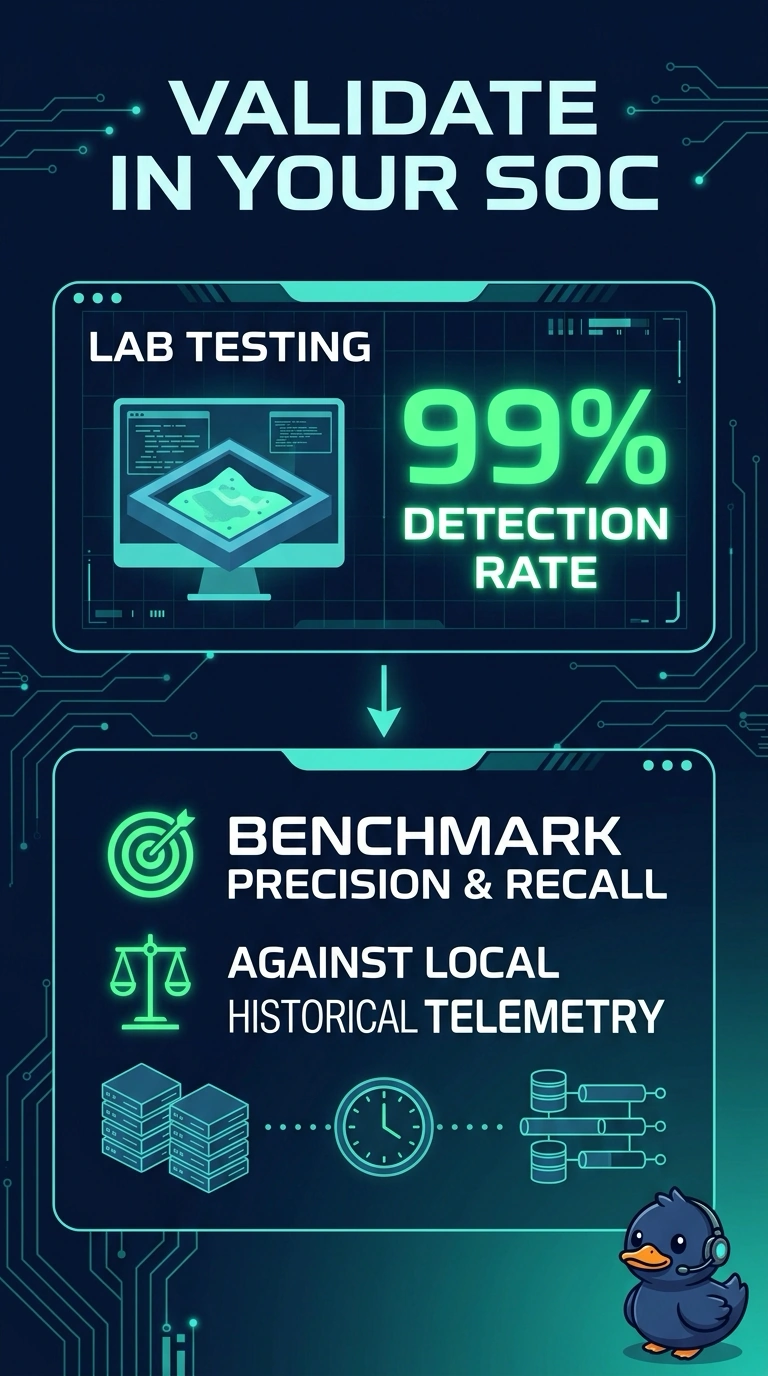
Benchmarking precision and recall against local historical telemetry is the right approach because machine learning models depend heavily on the specific baselines, applications, and user behaviors of the environment where they run. Measuring both true-positive detection and false-positive volume on your own logs reveals whether the tool surfaces real threats without overwhelming analysts. Comparing vendor-published detection accuracy scores on generic public datasets fails because synthetic or external traffic rarely reflects your organization's unique administrative patterns and custom applications. Counting total daily alerts generated during a one-week trial fails because raw alert volume says nothing about whether those alerts represent genuine attacks or benign noise. Verifying that the model uses deep neural network architectures fails because model complexity does not guarantee operational accuracy or explainability in a production SOC. Keep in mind as a caveat that historical telemetry must be representative of current operations, since recent infrastructure migrations can skew baseline comparisons. As an operational check, replay a curated set of past incident logs alongside typical business-hours traffic through the pilot tool and measure the resulting precision, recall, and analyst triage time.