
An enterprise relies heavily on perimeter next-generation firewalls and network intrusion sensors, yet an attacker compromises one workstation and spreads laterally across ten neighboring systems in the same subnet without triggering a single network alert. No internal traffic mirror, bridge sensor, or host telemetry feeds the perimeter detection platform. Why did these tools miss the activity?
Select an answer to reveal the explanation.
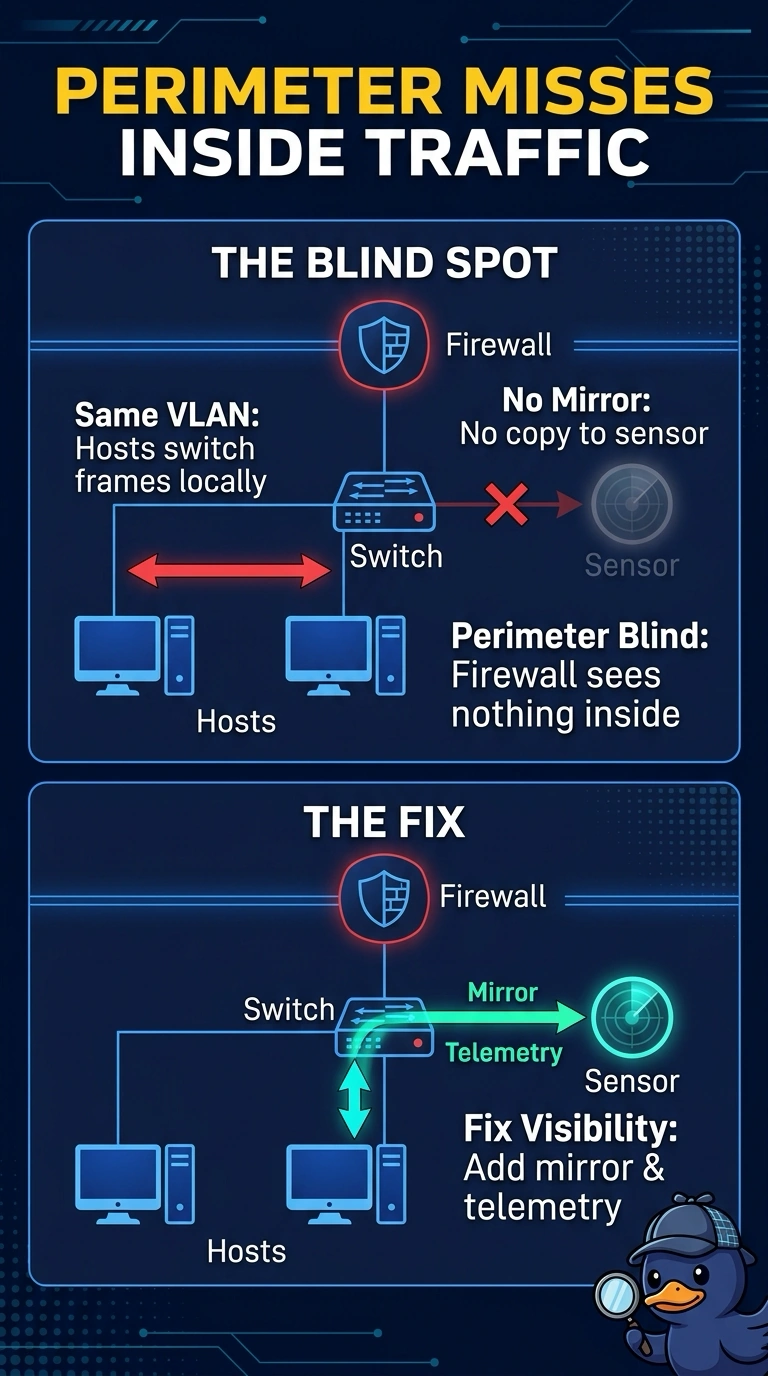
Short Explanation
Guard dogs at the front gate cannot see what happens inside the living room. The trap is assuming your perimeter firewall sees every packet, when you have local east-west traffic that can bypass those sensors on this network with no mirror or host feed.
Full Explanation
Local east-west traffic can bypass perimeter sensors on this switched network explains this blind spot because devices on the same subnet communicate directly through Layer 2 switches without routing through the perimeter firewall. No internal traffic mirror, bridge sensor, or host telemetry feeds the perimeter detection platform, so lateral movement inside this flat VLAN remains invisible to perimeter tools, even though it could be inspected if mirrored or instrumented. Perimeter firewalls automatically inspect every frame switched within local subnets fails because switched intra-VLAN frames are forwarded locally by MAC address and do not traverse routed perimeter boundaries. Signature engines are prohibited from parsing internal private address ranges fails because network sensors can inspect internal IP ranges whenever traffic actually passes through their interfaces. Layer 2 access switches encrypt all intra-VLAN workstation traffic by default fails because standard access switching does not encrypt local frames by default, and the issue is traffic path rather than encryption. As a caveat, even routed internal traffic can bypass perimeter sensors if core switches route between internal VLANs without mirroring traffic to a sensor. As an operational check, map your network topology against sensor placement and verify that endpoint telemetry covers east-west lateral paths.