
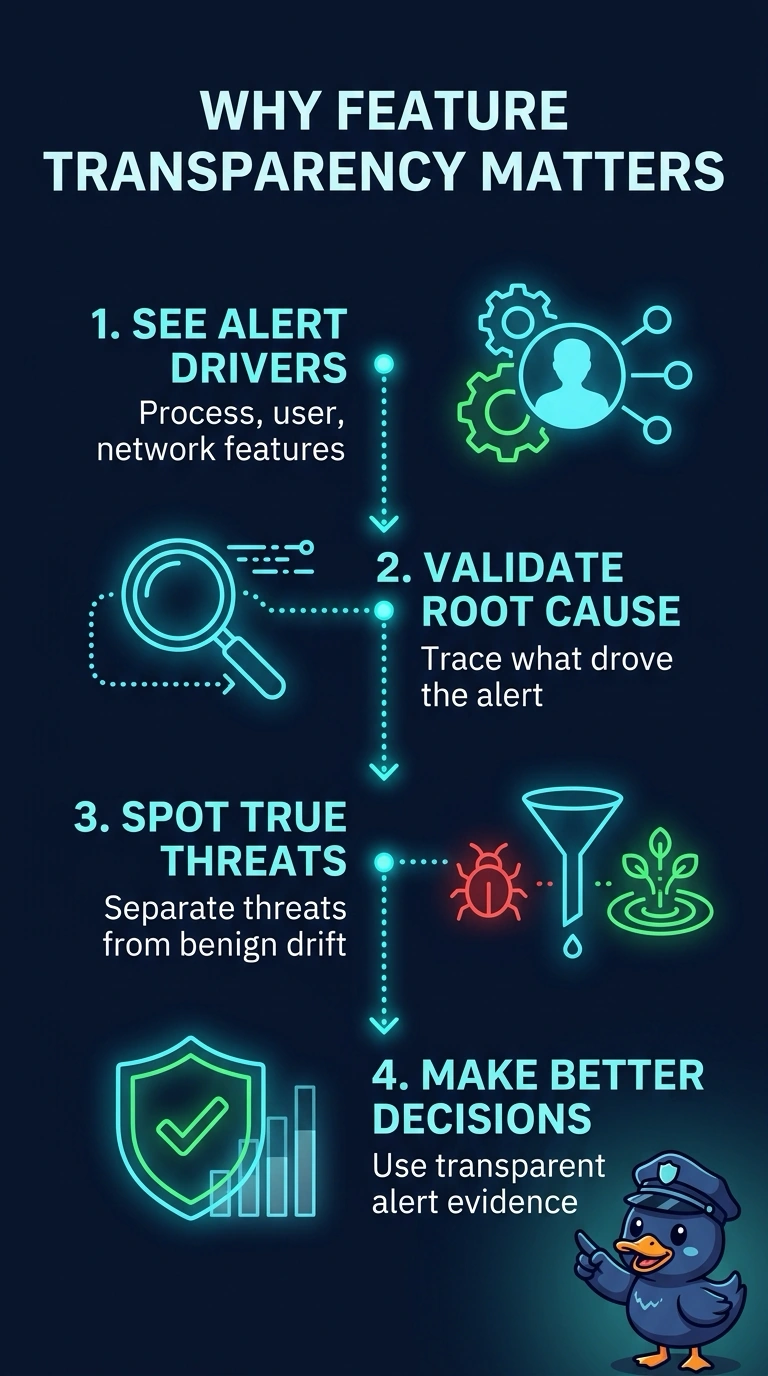
A healthcare SOC evaluates two machine learning anomaly detection tools: one outputs only a numeric risk score, while the other highlights the specific process, user, and network features that drove the alert. Why is feature transparency critical for threat hunters?
Select an answer to reveal the explanation.
Short Explanation
A black-box risk score without context is like a smoke alarm with no room number—you know something triggered, but not where to look. The trap is trusting opaque scores instead of requiring feature transparency your analysts can verify.
Full Explanation
It enables analysts to validate root cause and distinguish true threats from benign drift because knowing which process, user, or network attributes drove a machine learning score lets hunters inspect the underlying telemetry directly. Without feature transparency, SOC teams waste time chasing opaque high-risk alerts or dismissing real anomalies they cannot explain. It eliminates the need to collect endpoint process or authentication logs is false because machine learning models depend on rich, continuous telemetry as their input features. It guarantees zero false positives across all future software deployments is unrealistic, as legitimate business changes will always shift baselines and trigger occasional anomalies. It automatically patches vulnerable applications without administrator approval confuses behavioral anomaly detection with automated patch management. One caveat is that attackers can still attempt to mimic normal feature values, so model explanations should supplement rather than replace hypothesis-driven hunting. As an operational check, sample recent machine learning alerts and verify that analysts can trace every top contributing feature back to raw SIEM or endpoint logs.