
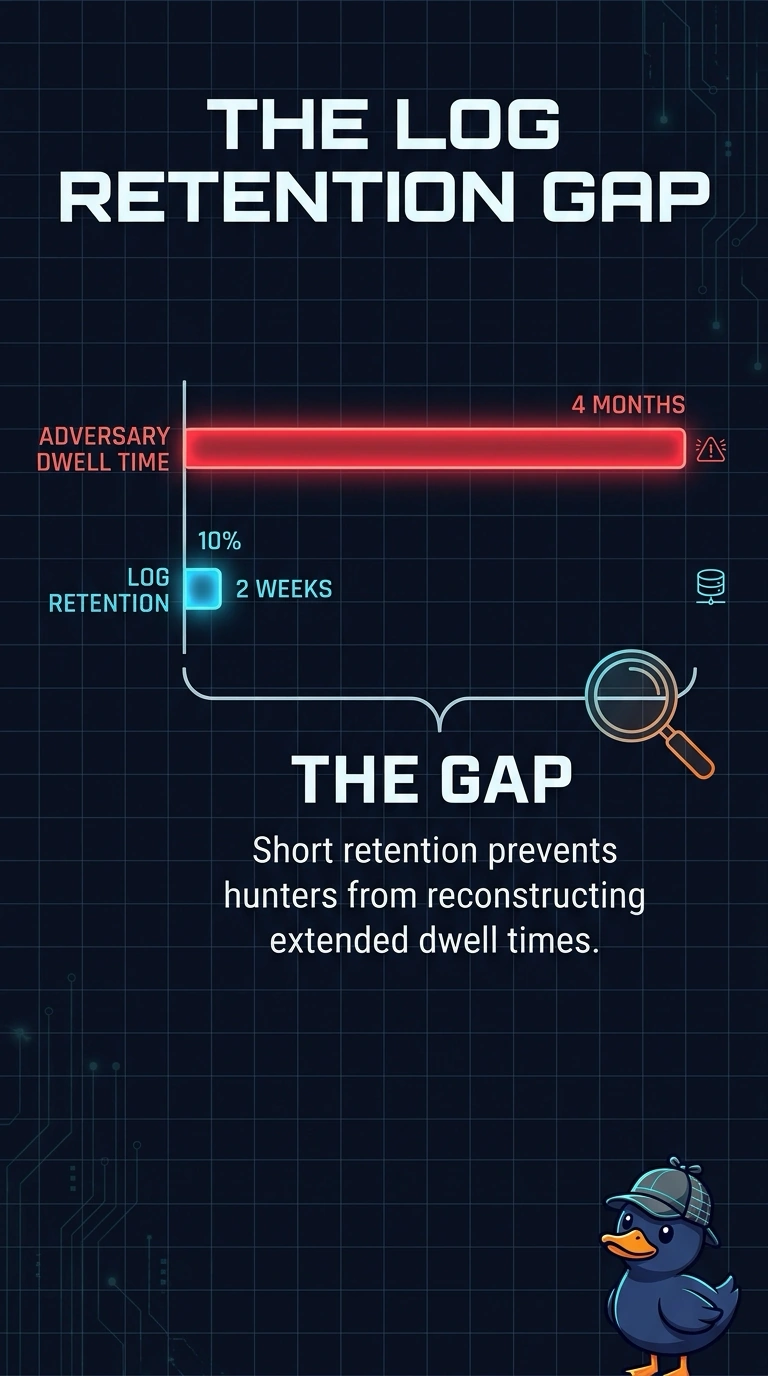
A manufacturing firm discovers that an advanced persistent threat operated inside its network for four months, yet endpoint and authentication logs only go back two weeks. What limitation does this scenario highlight for threat hunters?
Select an answer to reveal the explanation.
Short Explanation
If your security cameras overwrite footage every fourteen days, you will never see how a burglar walked in four months ago. The trap is assuming short default log retention is fine for threat hunting when patient adversaries routinely operate across months.
Full Explanation
This scenario illustrates how short log retention windows prevent hunters from reconstructing extended adversary dwell times. Patient threat actors often perform initial access, credential harvesting, and internal reconnaissance slowly over months, meaning crucial early-stage evidence disappears if logs age out after two weeks. Claiming that extended log retention automatically blocks attackers from escalating privileges on internal servers confuses passive forensic visibility with active preventive access control. Suggesting that advanced persistent threats always erase all centralized SIEM records before initiating lateral movement overstates attacker capabilities, because properly segregated centralized logging prevents attackers on compromised endpoints from altering historical copies. Likewise, assuming that two weeks of local endpoint logs is sufficient to detect every multi-month espionage campaign ignores the reality that initial compromise artifacts frequently predate the discovery of late-stage activity. As a caveat, retaining all raw packet captures for months can be cost-prohibitive, so organizations often keep compact metadata and key authentication or process events longer than full packet captures. As an operational check, review your SIEM and log-archive retention policies against realistic adversary dwell times and verify that critical identity and process logs remain queryable.