
A retail enterprise's SOC considers configuring its machine learning anomaly detector to automatically isolate any server that exceeds a high behavioral risk score. Why should the team keep human analyst validation in the loop for ambiguous anomaly alerts?
Select an answer to reveal the explanation.
Short Explanation
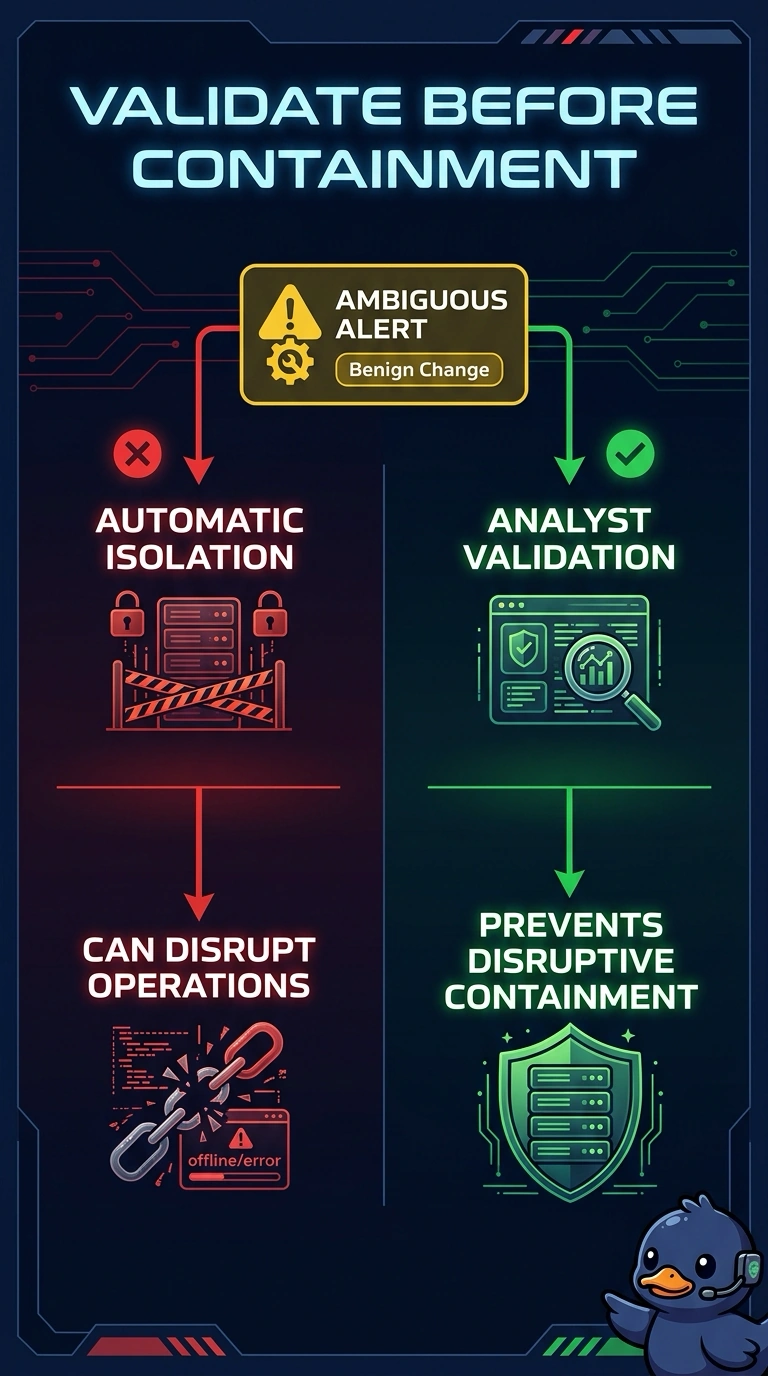
Machine learning is a sharp flashlight for your SOC, not an autopilot that should lock down production servers unsupervised. Analyst validation prevents benign operational changes from triggering disruptive containment when legitimate maintenance looks unusual. The trap is treating a statistical anomaly score as proof of malice.
Full Explanation
The correct reason is that Analyst validation prevents benign operational changes from triggering disruptive containment. Statistical and machine learning models measure deviation from historical baselines, which means legitimate events—such as emergency patching, seasonal traffic surges, or new administrative scripts—can produce high anomaly scores. Human analysts supply organizational context to verify whether an unusual pattern represents a genuine intrusion or authorized operations before taking production systems offline. The claim that Machine learning models automatically understand every organization's business context and risk tolerance is false because models only learn from observed features unless tuned with business context. Automated containment removes the need to investigate root cause or persistent adversary access is also wrong because isolating a host does not reveal initial entry or lateral spread. Finally, Anomaly scores always indicate confirmed malicious intent with zero false-positive risk is incorrect because statistical outliers frequently occur in dynamic IT environments. As a caveat, high-confidence, deterministic detections may still warrant automated blocking. For an operational check, compare recent high-scoring ML alerts against change-management tickets to measure the false-positive rate.