
A junior threat hunter is building a coverage matrix using MITRE ATT&CK and wants to distinguish why an adversary performs an action from the specific method used to accomplish it. How does the framework separate these two concepts?
Select an answer to reveal the explanation.
Short Explanation
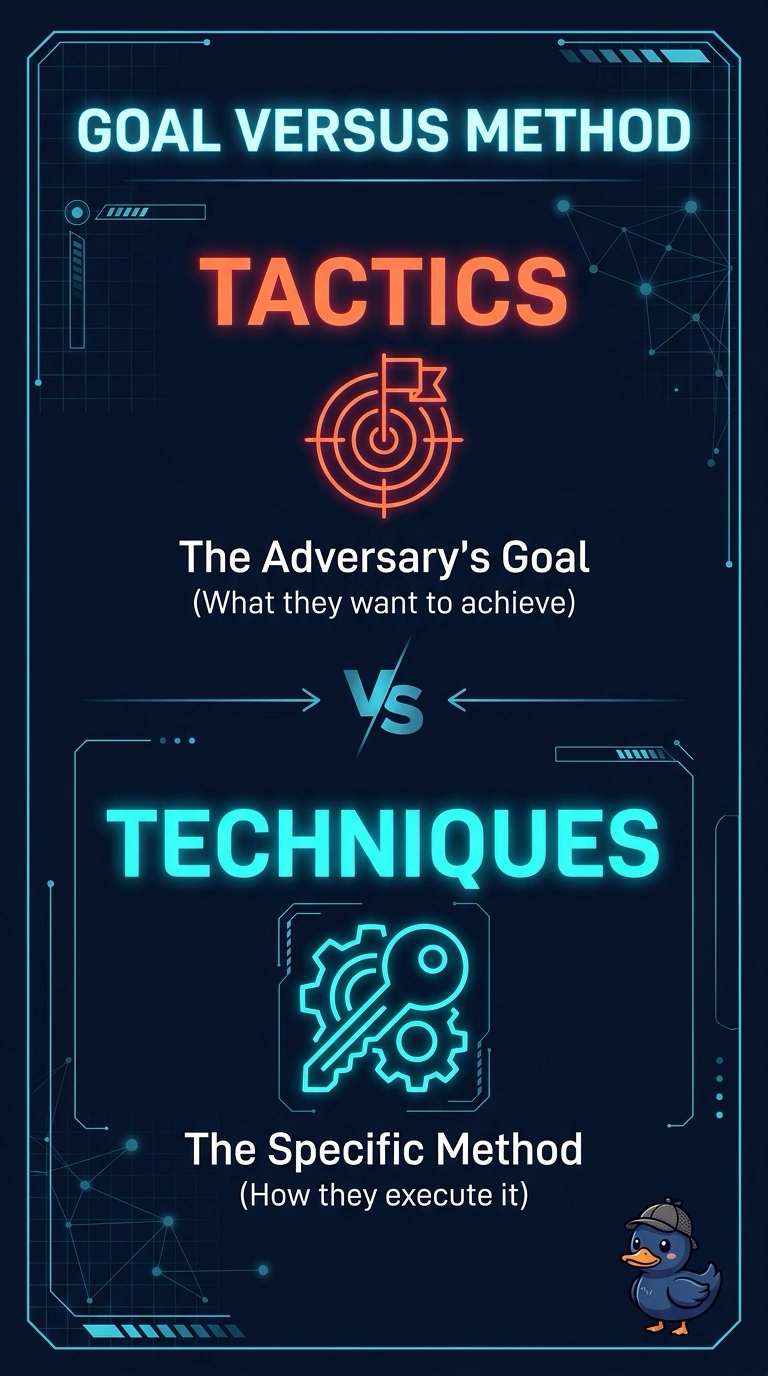
In MITRE ATT&CK, tactics are the destination on the map and techniques are the roads an attacker takes to get there. The trap is mixing up the why with the how, which can skew your detection coverage matrix.
Full Explanation
MITRE ATT&CK provides a structured taxonomy for describing adversary behavior across an intrusion lifecycle. Tactics represent the adversary's goal while techniques represent the specific method accurately captures how the framework separates the overarching technical objective, such as credential access or persistence, from the concrete action used to achieve it. Signatures represent the adversary's goal while indicators represent the software exploit confuses static detection artifacts with behavioral framework categories. Modules represent the adversary's goal while hashes represent the specific method misuses tooling and cryptographic file identifiers that do not define ATT&CK's core hierarchy. Phases represent the adversary's goal while risk scores represent the specific method conflates linear kill-chain stages and risk metrics with ATT&CK's behavioral taxonomy. A useful caveat is that a single technique can sometimes support multiple tactics depending on how the adversary sequences the operation. As an operational check, audit your SIEM detection rules by tagging each rule with both the tactic and technique it covers to spot gaps where one goal has many unmonitored methods.