
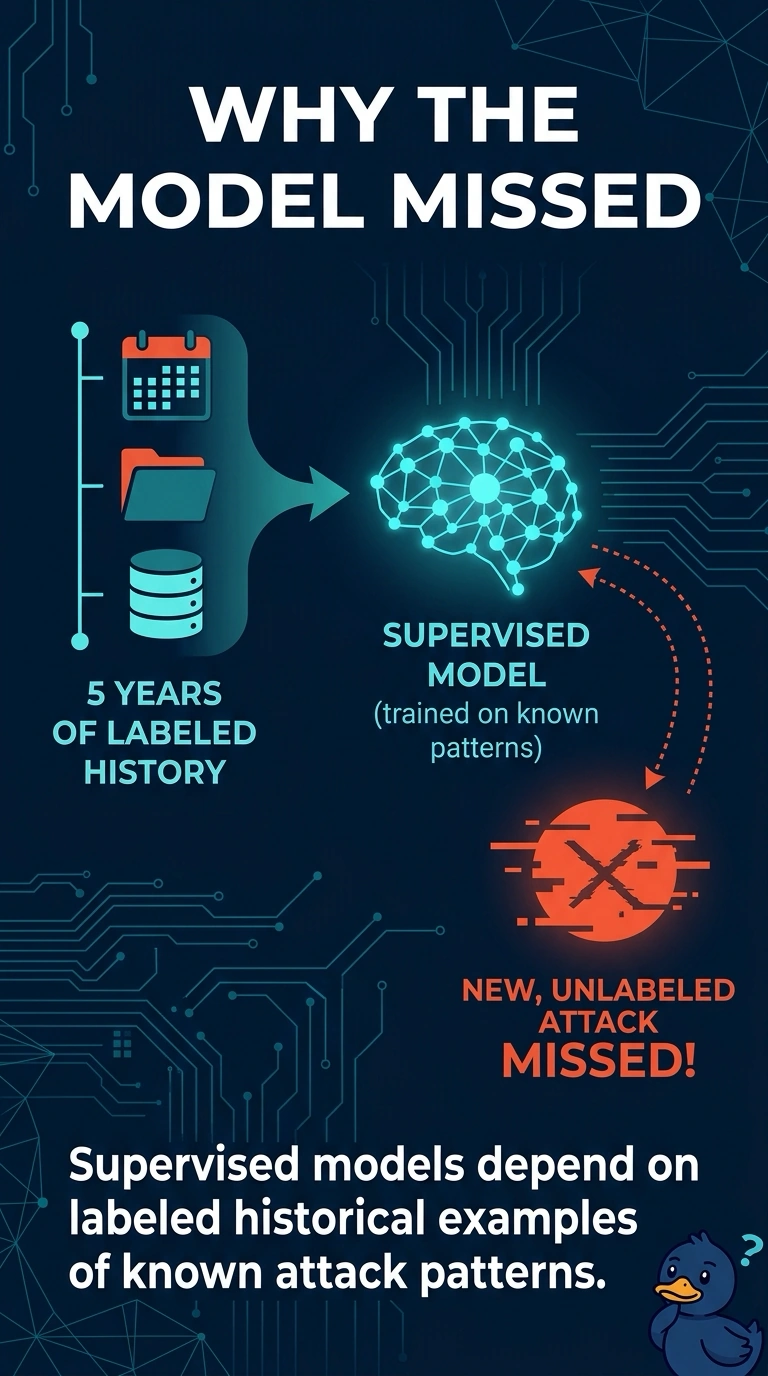
A financial firm's SOC deploys a supervised machine learning classifier trained on five years of labeled incident tickets to detect endpoint intrusions. During a later review, analysts discover the model missed a novel living-off-the-land technique. What explains this detection tool limit?
Select an answer to reveal the explanation.
Short Explanation
Think of a supervised classifier like a guard dog trained only on yesterday's intruders—if a burglar wears a brand-new disguise, the dog may walk right past. The trap is assuming machine learning automatically catches novel tradecraft, when in reality your model only recognizes patterns similar to its historical training labels.
Full Explanation
Supervised machine learning classifiers learn by generalizing from historical, labeled examples, so they struggle when adversaries adopt novel techniques absent from training data. Supervised models depend on labeled historical examples of known attack patterns, meaning previously unseen living-off-the-land behaviors often evade classification until new labeled samples are added. The claim that Supervised models operate only on network packet payloads rather than endpoint logs is incorrect because supervised classifiers routinely ingest endpoint, identity, and host telemetry. Suggesting that Supervised models automatically block every process that lacks a vendor signature confuses statistical classification with strict application allowlisting. Likewise, stating that Supervised models require manual analyst queries before evaluating any telemetry describes ad-hoc manual searching rather than automated model inference. One important caveat is that even well-trained supervised models degrade over time as legitimate administrative workflows and adversary tradecraft evolve. As an operational check, periodically test your SOC classifiers against recent adversary emulation telemetry and pair supervised models with behavioral hunting rules.