
A financial institution's threat hunting team has already built custom behavioral analytics and now converts its validated detection procedures into automated, continuous hunting workflows that run without manual analyst initiation. Which Threat Hunting Maturity Model level does this capability represent?
Select an answer to reveal the explanation.
Short Explanation
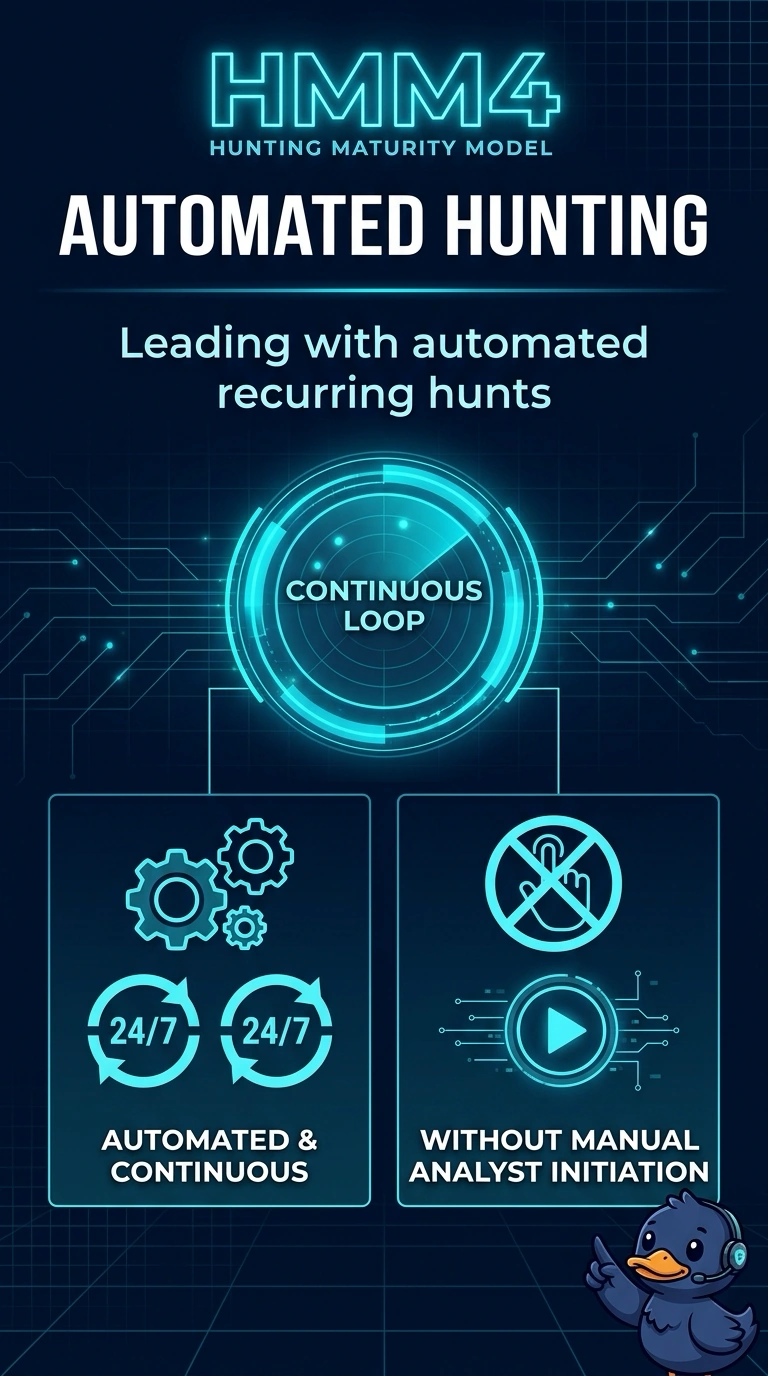
Think of threat hunting maturity like graduating from hand-written checklists to an autopilot that never sleeps. The trap is confusing custom analytics creation with full operational automation, which keeps analysts stuck running searches manually. When validated hunts run continuously without human initiation, you have reached HMM4 Leading.
Full Explanation
In the Threat Hunting Maturity Model, HMM4 Leading with automated recurring hunts represents the highest stage of operational maturity, where the organization converts proven hunting hypotheses and data analytics into automated, continuous workflows. This frees analysts to research emerging adversary behaviors rather than repeatedly executing manual queries. By contrast, HMM1 Minimal with basic indicator searches describes an early stage that relies mainly on automated alerts and ad-hoc lookups of external indicators without structured hunting. Similarly, HMM2 Procedural with recurring analyst hunts reflects a team that routinely runs documented hunts based on intelligence, yet still depends on human initiation. Meanwhile, HMM3 Innovative with manual statistical models focuses on building custom analytics and behavioral baselines, but stops short of automating those procedures into self-running detections. Caveat: automating a poorly tuned hunt simply generates high-volume alert noise at scale. As an operational check, review your automated hunting jobs quarterly to verify they still produce actionable findings and have not drifted from current infrastructure.