
A cloud security team deploys a new microservice architecture and wants to use machine learning to spot unusual behavior, but the SOC has no labeled historical attack data for this environment. Which machine learning approach is best suited for this situation?
Select an answer to reveal the explanation.
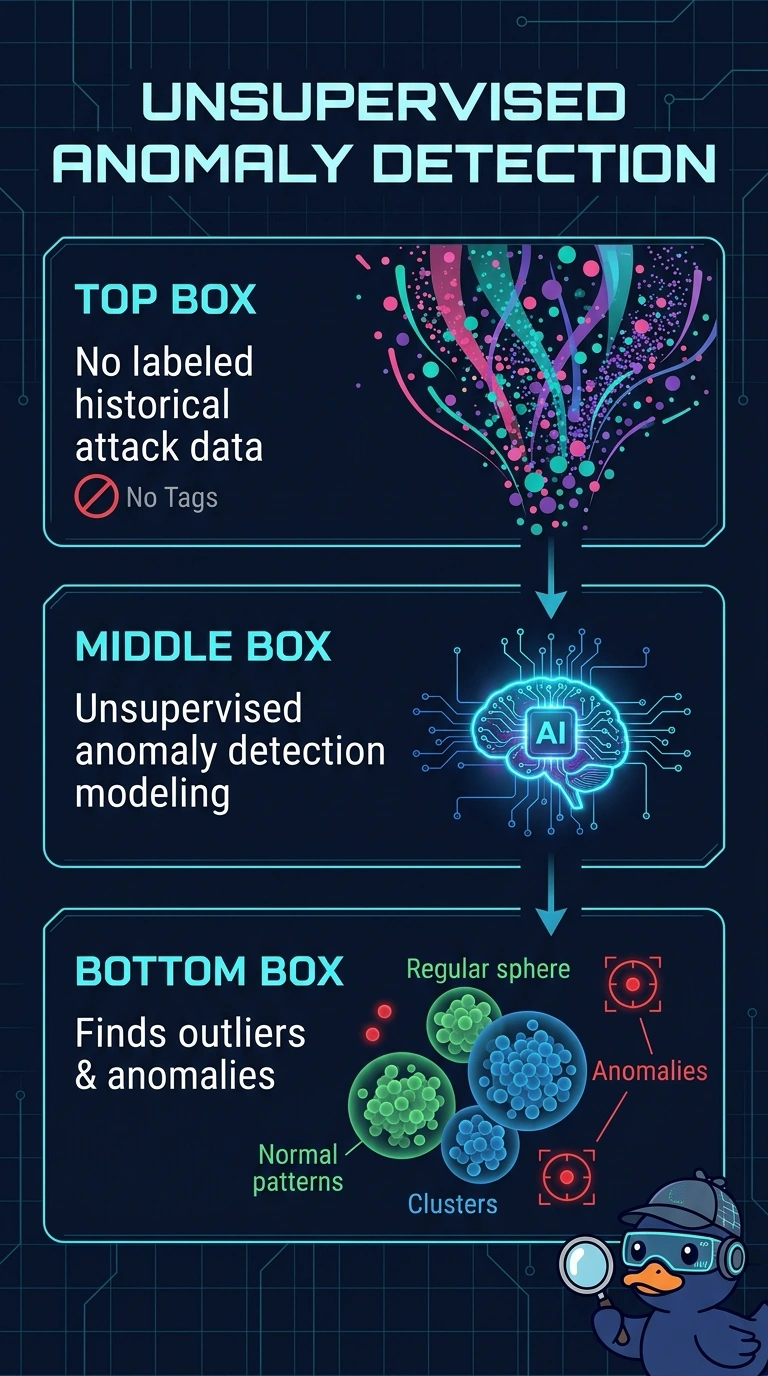
Short Explanation
Think of moving into a brand-new house where you do not yet know what trouble looks like, so you learn the normal daily rhythm first. The trap is forcing supervised models onto missing labels, which leaves your SOC blind to novel microservice abuse.
Full Explanation
Unsupervised anomaly detection modeling is the right choice because it learns baseline communication and workload patterns directly from unlabeled telemetry and flags statistically significant deviations without requiring pre-labeled incident datasets. By contrast, Supervised classification trained on legacy firewall alerts depends on labeled examples from an older perimeter architecture that do not reflect modern microservice API flows. Static signature matching against known malware hashes is not machine learning at all and fails whenever attackers use valid credentials, custom scripts, or cloud-native abuse. Deterministic rule correlation using fixed threshold counts relies on rigid manual thresholds rather than adaptive learning and breaks easily as microservice traffic scales dynamically. As an important caveat, unsupervised models often generate elevated false positives during initial deployment or after legitimate software releases, so hunters must continuously validate anomalies against expected service behavior. For an operational check, review the model's feature distributions and top anomaly scores alongside recent deployment records to confirm whether flagged deviations reflect benign scaling or unauthorized activity.